| Even before someone told the story of Athena turning Arachne into a spider for besting her in a weaving contest, people have been watching with fascination the work of spiders. Cultures all around the world have gods, goddesses or just stories of spider-creatures who spun and sometimes taught humans to spin thread for clothing and other needs. There is also the story of the spiders of Biblical Egypt who spun their webs across the front of a hollow in a tree to hide Mary |
by the fact that it sounded a bit like guitar strings, pinging like metallic guitar strings. I
mean, it is a very, very unusual material."
A very careful person simply pulls the thread out of each spider and wraps it on a
spindle. It's then put on a hand loom and woven.
The main threads consist of 96 twisted silk lines. The brocaded patterns in the tapestry
— stylized birds and flowers — are woven with threads made up of 960 spider silk
lines.
Peers says they never broke a single strand, yet the tapestry is as soft as cashmere.
Peers and Godley say they spent a half-million dollars of their own money to make the
tapestry, which is on display at the museum for several months.
Of course, it would have been easier if the weavers could just have farmed their
spiders, silking them at regular intervals. Alas, Peers notes, the females are cannibalistic
“so we’d have had this endlessly diminishing stock.”
It took the better part of three years to get enough silk for the team to begin weaving in
earnest. The thread's elasticity — it can stretch up to 40 percent of its resting length —
made the silk difficult to work with. But it proved very strong, Peers says, “and never
broke, which was wonderful because ordinary silk does break.”
mean, it is a very, very unusual material."
A very careful person simply pulls the thread out of each spider and wraps it on a
spindle. It's then put on a hand loom and woven.
The main threads consist of 96 twisted silk lines. The brocaded patterns in the tapestry
— stylized birds and flowers — are woven with threads made up of 960 spider silk
lines.
Peers says they never broke a single strand, yet the tapestry is as soft as cashmere.
Peers and Godley say they spent a half-million dollars of their own money to make the
tapestry, which is on display at the museum for several months.
Of course, it would have been easier if the weavers could just have farmed their
spiders, silking them at regular intervals. Alas, Peers notes, the females are cannibalistic
“so we’d have had this endlessly diminishing stock.”
It took the better part of three years to get enough silk for the team to begin weaving in
earnest. The thread's elasticity — it can stretch up to 40 percent of its resting length —
made the silk difficult to work with. But it proved very strong, Peers says, “and never
broke, which was wonderful because ordinary silk does break.”
It then sat on a shelf in his office for years. Many, many years.
Eventually, Godley, another manufacturer of Madagascan textiles, noticed it while
visiting Peers. When he heard what it was, he couldn’t forget it. After a few years
Godley moved his company to the capital city, Antananarivo, where he could join
forces with Peers to begin working with spider silk.
After tracking down archival information on the history of this material and the machine
that could extract the strong fibers from these tiny animals, the two textile experts
applied some modernizations. Then they had their 21st century silker manufactured. It
can pull silk from 24 spiders at a time.
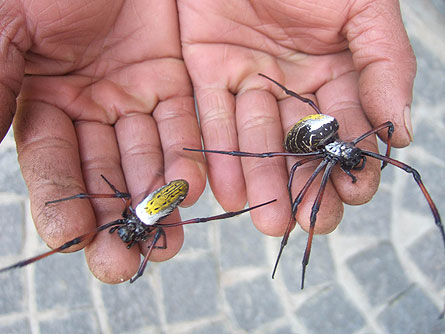
For their massive project, Peers and Godley used a local species, the golden orb spider
(Nephila madagascariensis). They temporarily harnessed each live spinner while some
80 feet of saffron-hued silk was extracted from a spinneret at the end of her abdomen.
Yes, her abdomen, since only females build webs.
Every spider was gently restrained in the silker for the five to 10 minute procedure,
then returned to her box. The two-dozen strands that were pulled from each team of
silked spiders were immediately twisted together and wound onto a bobbin. Eventually,
four of these multi-stranded lines were twisted together to create the ultimate textile
thread.
It took a lot of spiders to make the 11-by-4-foot fringed tapestry that went on display
today. Some 1,063,000 individuals, give or take (although it’s certainly possible some
were silked more than once). Teams of up to 80 people went out every day carefully
collecting spiders from webs in town and the countryside. Spider wranglers would
rebox each silked animal for release back into the wild a few hours later. In theory, no
spider gave her life for the production of Peers’ and Godley’s arachno-craft.
Eventually, Godley, another manufacturer of Madagascan textiles, noticed it while
visiting Peers. When he heard what it was, he couldn’t forget it. After a few years
Godley moved his company to the capital city, Antananarivo, where he could join
forces with Peers to begin working with spider silk.
After tracking down archival information on the history of this material and the machine
that could extract the strong fibers from these tiny animals, the two textile experts
applied some modernizations. Then they had their 21st century silker manufactured. It
can pull silk from 24 spiders at a time.
For their massive project, Peers and Godley used a local species, the golden orb spider
(Nephila madagascariensis). They temporarily harnessed each live spinner while some
80 feet of saffron-hued silk was extracted from a spinneret at the end of her abdomen.
Yes, her abdomen, since only females build webs.
Every spider was gently restrained in the silker for the five to 10 minute procedure,
then returned to her box. The two-dozen strands that were pulled from each team of
silked spiders were immediately twisted together and wound onto a bobbin. Eventually,
four of these multi-stranded lines were twisted together to create the ultimate textile
thread.
It took a lot of spiders to make the 11-by-4-foot fringed tapestry that went on display
today. Some 1,063,000 individuals, give or take (although it’s certainly possible some
were silked more than once). Teams of up to 80 people went out every day carefully
collecting spiders from webs in town and the countryside. Spider wranglers would
rebox each silked animal for release back into the wild a few hours later. In theory, no
spider gave her life for the production of Peers’ and Godley’s arachno-craft.
| LITTLE MISS MUFFET NEVER SAT SUCH A TUFFET Simon Peers, A British Art Historian, Using cobwebs of the Golden Spiders, Created a most unique tapestry Capturing thread of the spiders as providers. At the American Museum of Natural History, Costing half a million to create the spread, Made in England by hand using 70 people. I imagine that the spiders were all well fed. Robert Edward McKenna Quiz Poet Laureate ***** A million spiders in a row Knitting, perling just for show Making cloth that's oh so rare And adding their artistic flair. The humans claim the genius here But it's not so really true. The spiders should be recognized, And Mother Nature too! Colleen Fitzpatrick Understudy to Quiz Poet Laureate Robert Edward McKenna |

 |  |  |  |
| If you have a picture you'd like us to feature a picture in a future quiz, please email it to us at CFitzp@aol.com. If we use it, you will receive a free analysis of your picture. You will also receive a free Forensic Genealogy CD or a 10% discount towards the purchase of the Forensic Genealogy book. |




 |  |  |  |
| Answers: 1. Spider Silk 2. Madagascar 3. On display at the American Museum of Natural History, New York |
| ********** |
| ********** |

| If you enjoy our quizzes, don't forget to order our books! Click here. |

| Quiz #228 Results |

| How Norm Solved the Puzzle |
| I was able to obtain information on this week’s quiz by searching on Google with the words “gold tapestry news”. I noted the reference to the display at the American Museum of Natural History and was able to get the information necessary to complete the quiz at the following web site http://www.npr.org/templates/story/story.php?storyId=113223398. Norm Smith |

| How Spiders Spin Silk http://www.chm.bris.ac.uk/motm/spider/page2.htm |
1. Not all spiders weave webs.
2. Spiders do not stick to their own web because only the central spiral part of the web
is sticky, not the spokes. The spider knows where to tread!
3. Webs lose their stickiness after about a day due to factors such as dust accumulation
and exposure to air. In order to save energy the spider eats its own web before making
a new one so the protein used for the silk threads is recycled.
4. The silk of the Nephila spider is the strongest natural fiber known to man and is
used to make tote bags and fish nets.
5. Some silk strands are stronger than steel strands of the same thickness.
6. A spider’s silk line is only .001-.004 mm thick.
7. At one time, it was common to use spider silk as a thread for crosshairs in
telescopes, microscopes and similar optical instruments.
8. A strand of spider silk long enough to circle the Earth would weigh less than 500
grams (16 oz).
2. Spiders do not stick to their own web because only the central spiral part of the web
is sticky, not the spokes. The spider knows where to tread!
3. Webs lose their stickiness after about a day due to factors such as dust accumulation
and exposure to air. In order to save energy the spider eats its own web before making
a new one so the protein used for the silk threads is recycled.
4. The silk of the Nephila spider is the strongest natural fiber known to man and is
used to make tote bags and fish nets.
5. Some silk strands are stronger than steel strands of the same thickness.
6. A spider’s silk line is only .001-.004 mm thick.
7. At one time, it was common to use spider silk as a thread for crosshairs in
telescopes, microscopes and similar optical instruments.
8. A strand of spider silk long enough to circle the Earth would weigh less than 500
grams (16 oz).
"The spiders are harnessed ... held down in a
delicate way," Godley says, "so you need people to
do this who are very tactile so the spiders are not
harmed. So there's a chain of about 80 people who
go out every morning at four o'clock, collect
spiders, we get them in by 10 o'clock. They're in
boxes, they're numbered, and then as they get
silked, about 20 minutes later, they get released
back into nature."
"It's called dragline silk," he says. "A spider can
produce up to seven different types of silk. The
dragline is what frames the web; it's the thicker
silk on the outside. Also, it's extremely strong. The
first panel that we wove, we were quite stunned
| ********** |
| Interesting Facts about Spider Webs |
Spider silk is as strong as many industrial fibers (see tensile strength for common
comparisons). There is commercial interest in duplicating spider silk artificially, since
spiders use renewable materials as input and operate at room temperature, low
pressures and using water as a solvent. However, it has been difficult to find a
commercially viable process to mass-produce spider silk.
It is generally considered not possible to use spiders themselves to produce industrially
useful quantities of spider silk, due to the difficulties of managing large quantities of
small spiders (although this was tried with Nephila silk). Compared with silkworms,
spiders are aggressive and will eat one another, making it inadvisable to keep many
spiders together in the same space. Other efforts have involved extracting the spider
silk gene and using other organisms to produce the required amount of spider silk. In
2000, Nexia, a Canadian biotechnology company, was successful in producing spider
silk protein in transgenic goats. These goats carried the gene for spider silk protein, and
the milk produced by the goats contained significant quantities of the protein (1-2
grams of silk proteins per litre of milk). Attempts to spin the protein into a fiber similar
to natural spider silk resulted in fibers with tenacities of 2-3 grams per denier (see
BioSteel).
Extrusion of protein fibers in an aqueous environment is known as 'wet-spinning'. This
process has so far produced silk fibers of diameters ranging from 10-60 μm, compared
to diameters of 2.5-4 μm seen in natural spider silk.
The spider's highly sophisticated spinneret is instrumental in organizing the silk proteins
into strong domains. Specifically, the spinneret creates a gradient of protein
concentration, pH, and pressure, which drive the protein solution through liquid
crystalline phase transitions, ultimately generating the required silk structure (which is a
mixture of crystalline and amorphous biopolymer regions). Replicating these complex
conditions in lab environment has proved difficult. Nexia used wet spinning and
squeezed the silk protein solution through small extrusion holes in order to simulate the
behavior of the spinneret, but this has so far not been sufficient to replicate the exact
properties of the native spider silk.
comparisons). There is commercial interest in duplicating spider silk artificially, since
spiders use renewable materials as input and operate at room temperature, low
pressures and using water as a solvent. However, it has been difficult to find a
commercially viable process to mass-produce spider silk.
It is generally considered not possible to use spiders themselves to produce industrially
useful quantities of spider silk, due to the difficulties of managing large quantities of
small spiders (although this was tried with Nephila silk). Compared with silkworms,
spiders are aggressive and will eat one another, making it inadvisable to keep many
spiders together in the same space. Other efforts have involved extracting the spider
silk gene and using other organisms to produce the required amount of spider silk. In
2000, Nexia, a Canadian biotechnology company, was successful in producing spider
silk protein in transgenic goats. These goats carried the gene for spider silk protein, and
the milk produced by the goats contained significant quantities of the protein (1-2
grams of silk proteins per litre of milk). Attempts to spin the protein into a fiber similar
to natural spider silk resulted in fibers with tenacities of 2-3 grams per denier (see
BioSteel).
Extrusion of protein fibers in an aqueous environment is known as 'wet-spinning'. This
process has so far produced silk fibers of diameters ranging from 10-60 μm, compared
to diameters of 2.5-4 μm seen in natural spider silk.
The spider's highly sophisticated spinneret is instrumental in organizing the silk proteins
into strong domains. Specifically, the spinneret creates a gradient of protein
concentration, pH, and pressure, which drive the protein solution through liquid
crystalline phase transitions, ultimately generating the required silk structure (which is a
mixture of crystalline and amorphous biopolymer regions). Replicating these complex
conditions in lab environment has proved difficult. Nexia used wet spinning and
squeezed the silk protein solution through small extrusion holes in order to simulate the
behavior of the spinneret, but this has so far not been sufficient to replicate the exact
properties of the native spider silk.
| Types of Spider Silk http://www.chm.bris.ac.uk/motm/spider/page2.htm |
| Comments from Our Readers |
*Silk from the minor ampullate gland is only half as strong as that from the major gland.
(Funny thing - on the page where I found the article, there was an ad at the bottom of
the page for Adios Pest Control :) Anne Alves
*****
I already solved this week's quizz, I think it's an attempt to link the Silk Road (History),
Spiderman (Pop Culture), Geography (Madagascar, & of course, NYC again !) , and
some folk's Arachnophobia (Psychology). . . . . . LOL. You will hear from me later on
in the week. Gee, since I started my involvement with your weekly quizzes, I am so
glad I keep up on current events, specifically reading the newspaper.
Bob Steinmann Jr.
*****
What does a spider harness look like? Pinky Palladino
N.B. I think a spider harness looks just like a horse's, only much smaller. I hear it's not
used very often because it's hard to get the bit in the spider's mouth.
*****
This is just beautiful, by the way. Karen Kay Bunting
*****
It is absolutely magnificent and I wish I lived closer so I could go to see the tapestry.
Sharon Martin
*****
Wow! I read that it took 1,063,000 spiders to make this 11 x 4 foot tapestry. I wonder
if it catches bugs. I hope none of our quizmasters have arachnophobia.
Carolyn Cornelius
N.B. No because they keep it in mothballs.
*****
I heard of this fabric on a costuming list- truly amazing stuff.
http://www.wired.com/wiredscience/2009/09/spider-silk/ Marjorie Wilser
N. B. Well if you want to go out in the morning and silk those spiders to get your
costuming material, more power to you! Get enough for me for a dress while you are at
it, OK?
*****
I love it when the first search gets the answer. Judy Pfaff
*****
Well, at least the spider's economy is going strong...our unemployment rate is up, but
yet it took over 1,000,000 spiders to make the tapestry. :) And they don't have to worry
about unions, since the females (the sex that makes the silk) are cannabalistic. And talk
about job security...took many years to make this piece. Carl Blessing
N.B. Yes it's comforting to know that spiders in Madagascar don't have to worry about
unemployment. It's terrible when spiders are on the dole.
*****
Solved by searching Google News for "tapestry" and looking at the top hits.
Joshua Kreitzer
*****
I first tried to track down the Shroud of Turin, thinking it was the replica that is said to
explain the process. My mind is a jumble of information and I keep on putting more in.
Gina Hudson
*****
I googled gold tapestry in the news for links to answers. The photo does not seem to
be on tineye nor time dated as on downloaded jpgs to pc.Images google search to luxist
and keyworded tapestry on their website. This took me to wired.com and to the
questions asked: This 11 by 14 foot gold coloured tapestry is made from the silk (milk)
of some one million female golden orb spiders in the country of Madagascar circa
1900. The tapestry is currently on display in the American Museum of Natural History
in New York City. Comments: reminds of the Rumplestiltskin Tale of spinning yarn into
gold. Our eight footed friends though scary in appearance, and unwelcome inside our
homes, have their role in nature --- outside. Webs of ordinary spiders quite fascinating
in detail and construction. As silk production: growing up we had an infestation of tent
caterpillars in a cherry tree. About a couple dozen of them could produce a soccer size
ball or tent of their silk on the end of some branches. Mike Dalton
*****
The more you read about this amazing project you realize how complicated was the
task. I read or heard phrases like “the efforts of 70 people who collected spiders daily
from webs on telephone wires, using long poles”, “hard to find people to work because
they get bitten on the hand”, “only females produce the silk web”, “used the silk of
1,063,000 spiders” (they actually counted?), “had to be done in the rainy season”, “cost
about $500, 000”, “Adult Golden Orb spider is almost as large as the human hand”,
“webs were spun between telephone wires”. It would be interesting to see the pay-roll
sheet for the work. Obviously the weaving itself would be the most intricate job. My
hope is that the collectors, who were locals, were well paid. Don Draper
*****
Finally, a way to make some extra cash! Down here in FL we have lots of Golden Orb
Weaver Spiders. Sure, they're not as big as the ones in Madagascar, but I'm certain
they are easily trainable. I should go to the American Natural History Museum in NYC
to view this one and 'study' the process, but I'll just figure it out by myself. If I gather
up a few hundred of these ladies and train them well (and learn how to weave) I can
come up with one of these tapestries in no time. Any buyers? I wonder if my wife is
going to mind and I'm not sure in which room to house them? Dennis Brann
*****
Spider silk, and spiders, have always amazed me. What a project that must have been to
create that tapestry. Yes, I'm in awe of nature. Peter Norton
*****
That is really interesting about the spider silk but it would make sense that it would have
to be strong, wouldn't do the spider much good if it broke at the slightest force. They
are such fascinating creatures to watch, pet crabs are my hobby but they are closely
related to spiders; always nice to learn new things about these creatures. :)
Nicole Blank
*****
I’ve been busy with other things lately but have always surfed in to see the quizzes and
read the fascinating answers as they are always a lesson to help grow my knowledge of
the world. Just as this one on the silk. As you said nature is really wonderful, indeed it
is and gives us millions of puzzles to solve. Fred Stuart
the page for Adios Pest Control :) Anne Alves
*****
I already solved this week's quizz, I think it's an attempt to link the Silk Road (History),
Spiderman (Pop Culture), Geography (Madagascar, & of course, NYC again !) , and
some folk's Arachnophobia (Psychology). . . . . . LOL. You will hear from me later on
in the week. Gee, since I started my involvement with your weekly quizzes, I am so
glad I keep up on current events, specifically reading the newspaper.
Bob Steinmann Jr.
*****
What does a spider harness look like? Pinky Palladino
N.B. I think a spider harness looks just like a horse's, only much smaller. I hear it's not
used very often because it's hard to get the bit in the spider's mouth.
*****
This is just beautiful, by the way. Karen Kay Bunting
*****
It is absolutely magnificent and I wish I lived closer so I could go to see the tapestry.
Sharon Martin
*****
Wow! I read that it took 1,063,000 spiders to make this 11 x 4 foot tapestry. I wonder
if it catches bugs. I hope none of our quizmasters have arachnophobia.
Carolyn Cornelius
N.B. No because they keep it in mothballs.
*****
I heard of this fabric on a costuming list- truly amazing stuff.
http://www.wired.com/wiredscience/2009/09/spider-silk/ Marjorie Wilser
N. B. Well if you want to go out in the morning and silk those spiders to get your
costuming material, more power to you! Get enough for me for a dress while you are at
it, OK?
*****
I love it when the first search gets the answer. Judy Pfaff
*****
Well, at least the spider's economy is going strong...our unemployment rate is up, but
yet it took over 1,000,000 spiders to make the tapestry. :) And they don't have to worry
about unions, since the females (the sex that makes the silk) are cannabalistic. And talk
about job security...took many years to make this piece. Carl Blessing
N.B. Yes it's comforting to know that spiders in Madagascar don't have to worry about
unemployment. It's terrible when spiders are on the dole.
*****
Solved by searching Google News for "tapestry" and looking at the top hits.
Joshua Kreitzer
*****
I first tried to track down the Shroud of Turin, thinking it was the replica that is said to
explain the process. My mind is a jumble of information and I keep on putting more in.
Gina Hudson
*****
I googled gold tapestry in the news for links to answers. The photo does not seem to
be on tineye nor time dated as on downloaded jpgs to pc.Images google search to luxist
and keyworded tapestry on their website. This took me to wired.com and to the
questions asked: This 11 by 14 foot gold coloured tapestry is made from the silk (milk)
of some one million female golden orb spiders in the country of Madagascar circa
1900. The tapestry is currently on display in the American Museum of Natural History
in New York City. Comments: reminds of the Rumplestiltskin Tale of spinning yarn into
gold. Our eight footed friends though scary in appearance, and unwelcome inside our
homes, have their role in nature --- outside. Webs of ordinary spiders quite fascinating
in detail and construction. As silk production: growing up we had an infestation of tent
caterpillars in a cherry tree. About a couple dozen of them could produce a soccer size
ball or tent of their silk on the end of some branches. Mike Dalton
*****
The more you read about this amazing project you realize how complicated was the
task. I read or heard phrases like “the efforts of 70 people who collected spiders daily
from webs on telephone wires, using long poles”, “hard to find people to work because
they get bitten on the hand”, “only females produce the silk web”, “used the silk of
1,063,000 spiders” (they actually counted?), “had to be done in the rainy season”, “cost
about $500, 000”, “Adult Golden Orb spider is almost as large as the human hand”,
“webs were spun between telephone wires”. It would be interesting to see the pay-roll
sheet for the work. Obviously the weaving itself would be the most intricate job. My
hope is that the collectors, who were locals, were well paid. Don Draper
*****
Finally, a way to make some extra cash! Down here in FL we have lots of Golden Orb
Weaver Spiders. Sure, they're not as big as the ones in Madagascar, but I'm certain
they are easily trainable. I should go to the American Natural History Museum in NYC
to view this one and 'study' the process, but I'll just figure it out by myself. If I gather
up a few hundred of these ladies and train them well (and learn how to weave) I can
come up with one of these tapestries in no time. Any buyers? I wonder if my wife is
going to mind and I'm not sure in which room to house them? Dennis Brann
*****
Spider silk, and spiders, have always amazed me. What a project that must have been to
create that tapestry. Yes, I'm in awe of nature. Peter Norton
*****
That is really interesting about the spider silk but it would make sense that it would have
to be strong, wouldn't do the spider much good if it broke at the slightest force. They
are such fascinating creatures to watch, pet crabs are my hobby but they are closely
related to spiders; always nice to learn new things about these creatures. :)
Nicole Blank
*****
I’ve been busy with other things lately but have always surfed in to see the quizzes and
read the fascinating answers as they are always a lesson to help grow my knowledge of
the world. Just as this one on the silk. As you said nature is really wonderful, indeed it
is and gives us millions of puzzles to solve. Fred Stuart
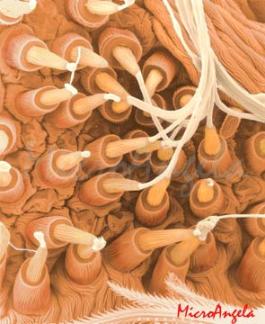
The glands are located on the lower
side of the abdomen (see diagram
below) and contain a watery fluid
known as 'dope'. This fluid passes
through to the spinneret via a multitude
of microscopic tubes where water
recovery and solidification begins.
Fluid from different glands can lead to
the same spinneret so silk with specific
properties required for a particular
function can be produced. There are
usually three pairs of spinnerets but this
can vary between 1 and 4 pairs
depending on the species. The
substance exits through the spiggots
which are mobile, finger-like
protrusions and the resulting silk
emerges as a solid. There are many
spigots so many fibres are bound
together like a cable. The diameter of a
single fibre is controlled by the
side of the abdomen (see diagram
below) and contain a watery fluid
known as 'dope'. This fluid passes
through to the spinneret via a multitude
of microscopic tubes where water
recovery and solidification begins.
Fluid from different glands can lead to
the same spinneret so silk with specific
properties required for a particular
function can be produced. There are
usually three pairs of spinnerets but this
can vary between 1 and 4 pairs
depending on the species. The
substance exits through the spiggots
which are mobile, finger-like
protrusions and the resulting silk
emerges as a solid. There are many
spigots so many fibres are bound
together like a cable. The diameter of a
single fibre is controlled by the
Here’s a hobby for weavers who adore
eight-legged spinners and have too much
time on their hands. Way too much time.
Indeed, Simon Peers and Nicholas
Godley can tell you why it may require a
village — and four years or more — to
create a single major textile from spider
silk. But their team’s effort is so
magnificent that starting today the
American Museum of Natural History, in
New York, has it on display. You’ve got
six months to see it there, after which
eight-legged spinners and have too much
time on their hands. Way too much time.
Indeed, Simon Peers and Nicholas
Godley can tell you why it may require a
village — and four years or more — to
create a single major textile from spider
silk. But their team’s effort is so
magnificent that starting today the
American Museum of Natural History, in
New York, has it on display. You’ve got
six months to see it there, after which
| ********** |
| Answers to Quiz #228 October 11 2009 |
muscular action of a valve. The faster and tighter the strand is drawn, the stronger the
silk.
silk.
| ********** |
| ********** |
| ********** |
| This tapestry was in the news recently. 1. What is it made out of? 2. In what country was it made? 3. Where is it now? |
| Thanks to long time Quizmaster Milene Rawlinson for suggesting this quiz. |
| Congratulations to Our Winners! Mr. Rick and Brand New Quizmaster Gabriel! Anne Alves Pam Long Mary South Charles Ellis Nienhaus Rick Roof Gerlad Vanlandingham Pinky Palladino Karen Kay Bunting Sharon Martin Carolyn Cornelius Dave Doucette Marjorie Wilser Norm Smith Judy Pfaff Carl Blessing Kathy Henderson Daniel E. Jolley Fred Stuart JoLynn Pfeiffer Nicole Blank Stan Read Peter Norton Alan Lemm Debby Sterbinsky Joshua Kreitzer Gary Sterne Wayne Douglas Betty Chambers Gina Hudson Margaret Paxton Marilyn Hamill Diane Burkett Mike Dalton Karen Petrus Don Draper John Sims Dennis Brann Jim Kiser Shirley Ferguson Blair Chambers Robert W. Steinmann, Jr. Lindsay Mackenzie Venita Wilson Jocelyn Thayer Robert Edward McKenna, Quiz Poet Laureate |

you’ll have to go museum hopping in London to catch up with it.
A Brit, Peers immigrated to Madagascar a couple decades ago and set up a business to
rediscover and promote that island nation’s woven artistic heritage. At some point,
maybe 18 years ago or so, he learned of what at first sounded like an apocryphal tale. It
described a piece of fabric that had been woven from threads of spider silk.
Intrigued, he chased down the story. Eventually he confirmed that someone had
produced enough silk to weave a textile, which was exhibited at the World’s Fair in
1900 — the Paris Exposition Universelle. “It was a sort of sheer, very plain silk
weave,” Peers notes. And although it was apparently big, “all of the sources that refer
to it conflict in terms of its size.” Try as he might to hunt it down, he says it's vanished.
Over the past three centuries, beginning in 1709, a guy here or there has produced a
pair of spider-silk gloves or stockings and presented them to royalty, Peers learned. But
despite years of looking, the only extant pieces appear to be two small remnants of
plain-weave fabric in Lyon, France.
A Brit, Peers immigrated to Madagascar a couple decades ago and set up a business to
rediscover and promote that island nation’s woven artistic heritage. At some point,
maybe 18 years ago or so, he learned of what at first sounded like an apocryphal tale. It
described a piece of fabric that had been woven from threads of spider silk.
Intrigued, he chased down the story. Eventually he confirmed that someone had
produced enough silk to weave a textile, which was exhibited at the World’s Fair in
1900 — the Paris Exposition Universelle. “It was a sort of sheer, very plain silk
weave,” Peers notes. And although it was apparently big, “all of the sources that refer
to it conflict in terms of its size.” Try as he might to hunt it down, he says it's vanished.
Over the past three centuries, beginning in 1709, a guy here or there has produced a
pair of spider-silk gloves or stockings and presented them to royalty, Peers learned. But
despite years of looking, the only extant pieces appear to be two small remnants of
plain-weave fabric in Lyon, France.

At some point, Peers shared what he had
learned with a friend who was doing
academic research on Madagascar’s
textiles. “And she enthused about this
whole idea of spider silk,” Peers recalls.
“In fact, she pursued it a little further
than I did,” turning up details of the
original machine that was used to “silk”
spiders for that World’s Fair fabric.
While in France, she had one small
element of the silker reproduced and
made Peers a present of the mechanical
piece.
learned with a friend who was doing
academic research on Madagascar’s
textiles. “And she enthused about this
whole idea of spider silk,” Peers recalls.
“In fact, she pursued it a little further
than I did,” turning up details of the
original machine that was used to “silk”
spiders for that World’s Fair fabric.
While in France, she had one small
element of the silker reproduced and
made Peers a present of the mechanical
piece.
| ********** |
| ********** |
|
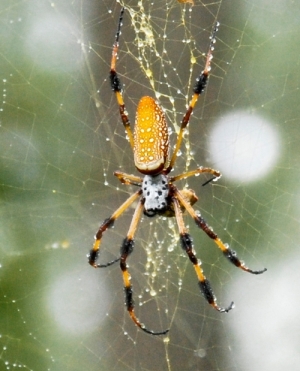
| Read more about golden orb spiders at: www.journalscene.com/culture/Golden-backyard-beauty |
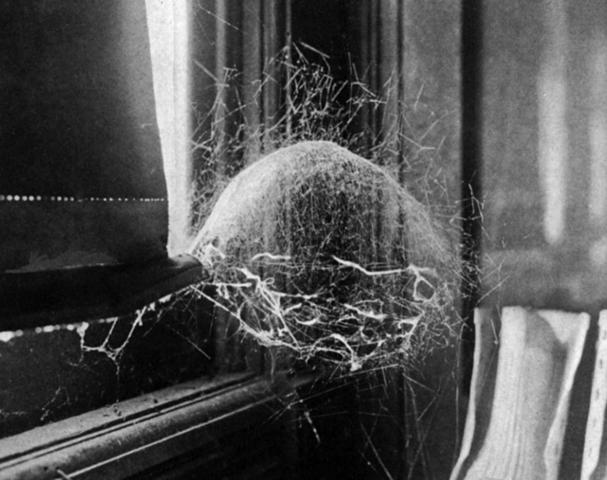
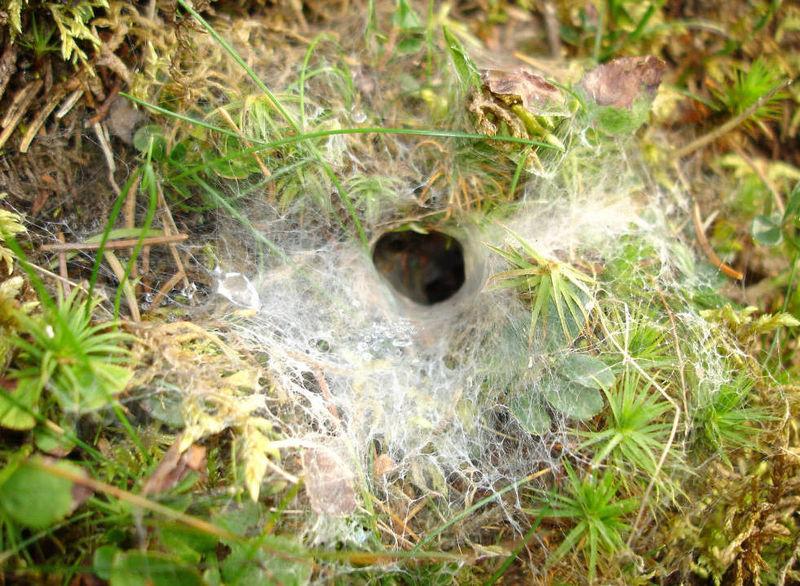
| Some Types of Spider Webs http://www.pestproducts.com/spider-webs.htm#Pictures |

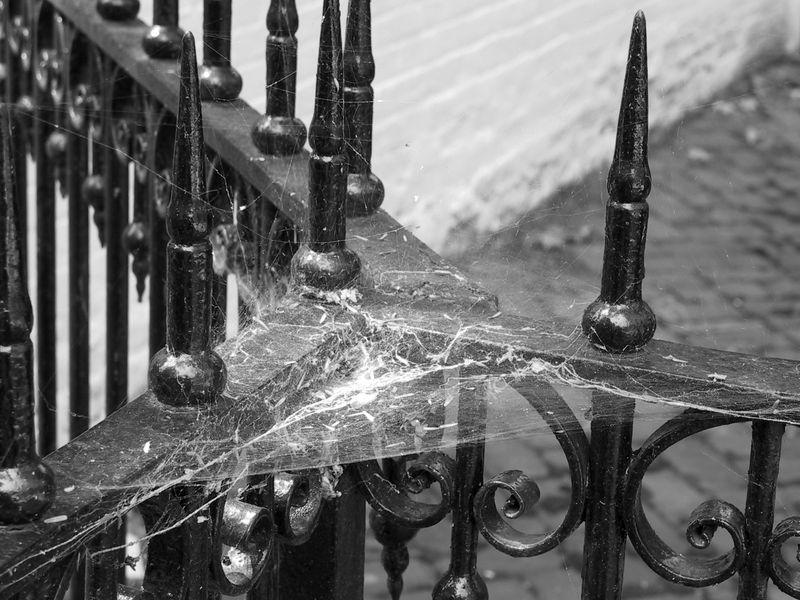
| Filmy dome web http://www.pestproducts.com/images/filmy-dome.jpg |


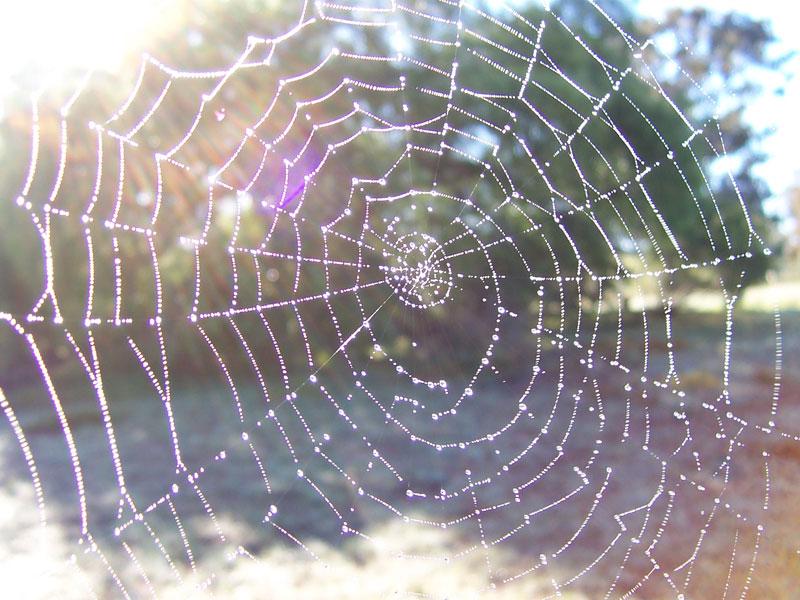
| Orb spider web http://www.pestproducts.com/images/orb-spider-web.JPG |

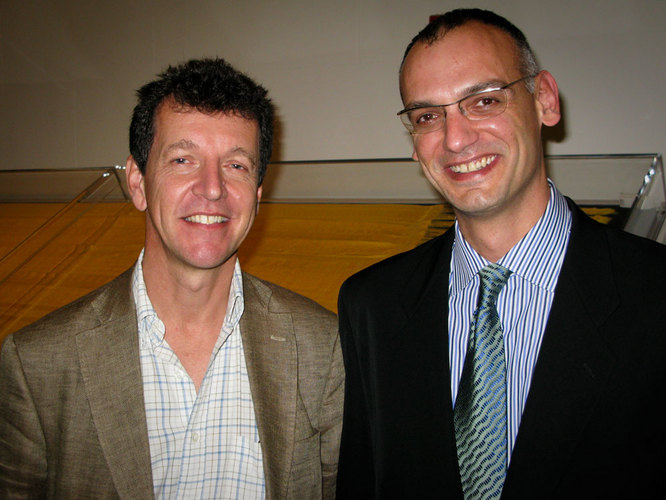
| Simon Peers and Nicholas Godley in front of spider silk tapestry at the American Museum of Natural History in New York. To hear their story on NPR, click here. |
| Artificial Spider Silk http://en.wikipedia.org/wiki/Spider_silk |
Weavers created the golden fabric in
panels and then assembled them
together into the final tapestry. Woven
into that fabric was a floral pattern
that includes birds.
“It really is mind-boggling the amount
of time that’s been invested in this
[piece],” Peers says. How much time?
“Hundreds of thousands of hours,” he
estimates, if you count the spider
collecting, silking and weaving. But
Peers and Godley set out to create a
work of art that was “truly unique and
extraordinary.”
And they succeeded.

| and the baby, Jesus, when they were fleeing Herod. In William Henry Hudson's book GREEN MANSIONS, Rima wears a dress made from spider silk, even though in the movie Rima is seen carding wool to spin into thread. http://www.worldinaspin.com/pages/Articles/Article_Spider.html |