Most of what is known about Ricetti has
been gleaned from observations of or
conversations with him. There is very
little documentation on Valerio Ricetti's life
in Australia and it is almost exclusively
confined to records of his internment,
dated 1942-45, held by National Archives
of Australia (Caillard 2005: 16-25)
confirm his internment as an enemy alien
between May 1942 and December 1943.
Much of the information contained in
these records is in the form of Ricetti's
been gleaned from observations of or
conversations with him. There is very
little documentation on Valerio Ricetti's life
in Australia and it is almost exclusively
confined to records of his internment,
dated 1942-45, held by National Archives
of Australia (Caillard 2005: 16-25)
confirm his internment as an enemy alien
between May 1942 and December 1943.
Much of the information contained in
these records is in the form of Ricetti's
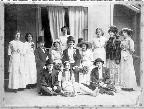
| I am an Italian immigrant. My home is on the State Heritage Register but it has no address. 1. What is my name? 2. Where is my home located? 3. What is unusual about it? Bonus: How did I try to pay my doctor bill after my accident? |

 |  |  |  |
| If you have a picture you'd like us to feature a picture in a future quiz, please email it to us at CFitzp@aol.com. If we use it, you will receive a free analysis of your picture. You will also receive a free Forensic Genealogy CD or a 10% discount towards the purchase of the Forensic Genealogy book. |


 |  |  |  |
| Answers: 1. Valerio Recetti 2. Griffith, New Zouth Wales, Australia 3. It is in a cave. Bonus: By secretly working in his garden in the middle of the night. |
| ********** |
| Click here to see results of 5th occasional photoquiz survey. |
| Quiz #198 - February 22, 2009 |
| ********** |
| ********** |


| If you enjoy our quizzes, don't forget to order our books! Click here. |

| Quiz #198 Results |
| Visit our blog at www.forensicgenealogy.info/blog. |

| Congratulations to Our Winners! Rex Cornelius Mike Swierczewski Michael Dalton Jina Yi and Rick Mackinney Jocelyn Thayer Mary Osmar Sandy McConathy Dan Schlesinger Dave Doucette Mary Hurley Joe McCabe Beth Long Gina Hudson Maureen O'Connor Jim Colvin Carolyn Cornelius Diane Burkett Sandy Thompson Brian Kemp Mark Brzys Don Draper Ted McChesney Marilyn Hamill Stan Read Margaret Waterman Laurel Fletchner Venita Wilson Marty Guidry Judy Pfaff Karen Kay Bunting Robert Edward McKenna, QPL |
| Comments from Our Readers |
Colleen, I must admit I spent hours on this quiz. Mr. Rick finally told me to relax! He
and Jina told me to think globally; ah, the advantages of having an older brother.
Jocelyn Thayer
*****
Try as I might I can't find anything about his doctor bill for the accident, but I'll keep
trying. Hopefully I can find it before you tell me the answer. This puzzle is a good
example of getting out of the box. As soon as I figured out that the State Heritage
Register was not THE UNITED STATES, I got on the right track right away. Finding
the answer made me so proud...which means this was a good puzzle. Just hard
enough. Mary Osmar
*****
This one was hard! Sandra McConathy
*****
The first clue to unravel this quiz was the State Heritage Register directs you to
Australia. After that it was a matter of luck for me to have found the answer.
Dan Schlesinger
*****
Note: Excellent puzzle: Bad assumption by me that immigrant meant US. Had to think
more 'globally'. State Register kept pointing to Australia - but I fought that...
Dave Doucette
*****
Yes, very interesting indeed. I was going way out there [researching the wrong
answer], looking at the Aus. Heritage Society and all of the recent work they did to add
the Italian migration to the Society, found gads of photos, etc. ;) Wrong!! ;) Of
course I found you some great links. Beth Long
*****
I'm interested in what that is he has hanging to dry in the quiz photo. It doesn't look
like either tobacco or marijuana. Couldn't find any likely candidates in articles on Ricetti
or NSW agriculture. Turns out Australia is the only place that uses the term "State
Heritage Register" so this was not as hard as it first looked. Sad to note this gentleman
died in his mid 50's so didn't have much time to enjoy all that work. Would love to see
his stone walls. Carolyn Cornelius
*****
It was very interesting. I’ve always been fascinated with the thought of just
disappearing from public and how people survive as a hermit. Obviously humans used
to live without the amenities of modern life (although their lives usually were a bit
shorter), but most of society has lost the knowledge that would enable them to do that
now.
As for the temperature in the caves – earth is a wonderful insulator. I’ve known of
houses specifically built partially underground for the purpose of the insulation it
afforded. I would imagine there were times it got pretty chilly though, but with a good
fire it might have been cozy. Brian Kemp
and Jina told me to think globally; ah, the advantages of having an older brother.
Jocelyn Thayer
*****
Try as I might I can't find anything about his doctor bill for the accident, but I'll keep
trying. Hopefully I can find it before you tell me the answer. This puzzle is a good
example of getting out of the box. As soon as I figured out that the State Heritage
Register was not THE UNITED STATES, I got on the right track right away. Finding
the answer made me so proud...which means this was a good puzzle. Just hard
enough. Mary Osmar
*****
This one was hard! Sandra McConathy
*****
The first clue to unravel this quiz was the State Heritage Register directs you to
Australia. After that it was a matter of luck for me to have found the answer.
Dan Schlesinger
*****
Note: Excellent puzzle: Bad assumption by me that immigrant meant US. Had to think
more 'globally'. State Register kept pointing to Australia - but I fought that...
Dave Doucette
*****
Yes, very interesting indeed. I was going way out there [researching the wrong
answer], looking at the Aus. Heritage Society and all of the recent work they did to add
the Italian migration to the Society, found gads of photos, etc. ;) Wrong!! ;) Of
course I found you some great links. Beth Long
*****
I'm interested in what that is he has hanging to dry in the quiz photo. It doesn't look
like either tobacco or marijuana. Couldn't find any likely candidates in articles on Ricetti
or NSW agriculture. Turns out Australia is the only place that uses the term "State
Heritage Register" so this was not as hard as it first looked. Sad to note this gentleman
died in his mid 50's so didn't have much time to enjoy all that work. Would love to see
his stone walls. Carolyn Cornelius
*****
It was very interesting. I’ve always been fascinated with the thought of just
disappearing from public and how people survive as a hermit. Obviously humans used
to live without the amenities of modern life (although their lives usually were a bit
shorter), but most of society has lost the knowledge that would enable them to do that
now.
As for the temperature in the caves – earth is a wonderful insulator. I’ve known of
houses specifically built partially underground for the purpose of the insulation it
afforded. I would imagine there were times it got pretty chilly though, but with a good
fire it might have been cozy. Brian Kemp
| LIVE ALONE AND LIKE IT Some people might have lived in a cottage, While apartments were also the rave, But he was content to continue to reside, In his self fashioned,comfortable cave. He was an Immigrant from Italy, To Australia's, Griffith, New South Wales, Valerio Ricetti, within his unique abode, A life style creating many interesting tales. An accident in his "Garden of Eden," Required extensive medical care, He repaid this medical practitioner, Nightly tending his garden, unaware. Robert Edward McKenna Quiz Poet Laureate |
| Valerio Ricetti |
| ********** |
| ********** |

| The Hermit http://www.blackmountainprojects.com... |
answers to a Military police Questionnaire prior to his internment in 1942. But very little
of this information provided by Ricetti can be substantiated by other documents.
Valerio Ricetti was born in north Italy around 1897-98 in Sondalo, a small town in a
valley in the Italian Alps, close to the border with Switzerland. There is no record of
Ricetti's date of birth. In 1942 it is recorded as 12 March 1897 (Caillard 2005: 7, 8,
11,12) and also as 12 March 1903 (http://naa12.naa.gov.au/scripts/Imagine.asp). He
would have been only 11 or 12 years old on arrival in Australia.
In his home region he was apprenticed as a cement and stonemason and gained
experience working on road and rail tunnel constructions. With the declining economic
situation and impending war in Europe, his uncle encouraged him to migrate to Australia
to seek better opportunities.
It is believed that he arrived at Port Pirie, South Australia, in October 1914, but his date
and port of entry into Australia cannot be verified. In 1942 he reported that he arrived in
1914 at Adelaide, date and ship's name unknown, that he paid his own fare and that he
had no family or friends in Australia on arrival (Caillard 2005: 7, 8, 11, 12). But there is
no record of his entry into a South Australian port as either a passenger, crew member,
or ship's deserter over a wide date range around 1914. Neither is he recorded entering
through a port in Western Australia or Victoria over an equally wide date range.
Passenger shipping arrivals into Sydney for this period are not indexed, therefore were
not searched (Heritage Office pers. comm. 2006: Adelaide, Perth, Melbourne; State
Records SA, NSW; Public Record Office Victoria).
of this information provided by Ricetti can be substantiated by other documents.
Valerio Ricetti was born in north Italy around 1897-98 in Sondalo, a small town in a
valley in the Italian Alps, close to the border with Switzerland. There is no record of
Ricetti's date of birth. In 1942 it is recorded as 12 March 1897 (Caillard 2005: 7, 8,
11,12) and also as 12 March 1903 (http://naa12.naa.gov.au/scripts/Imagine.asp). He
would have been only 11 or 12 years old on arrival in Australia.
In his home region he was apprenticed as a cement and stonemason and gained
experience working on road and rail tunnel constructions. With the declining economic
situation and impending war in Europe, his uncle encouraged him to migrate to Australia
to seek better opportunities.
It is believed that he arrived at Port Pirie, South Australia, in October 1914, but his date
and port of entry into Australia cannot be verified. In 1942 he reported that he arrived in
1914 at Adelaide, date and ship's name unknown, that he paid his own fare and that he
had no family or friends in Australia on arrival (Caillard 2005: 7, 8, 11, 12). But there is
no record of his entry into a South Australian port as either a passenger, crew member,
or ship's deserter over a wide date range around 1914. Neither is he recorded entering
through a port in Western Australia or Victoria over an equally wide date range.
Passenger shipping arrivals into Sydney for this period are not indexed, therefore were
not searched (Heritage Office pers. comm. 2006: Adelaide, Perth, Melbourne; State
Records SA, NSW; Public Record Office Victoria).

On arrival in Australia, Ricetti claims to
have spent about one year in a mental
hospital in South Australia, after which he
went to Alice Springs and on to the
Northern Territory.
Ricetti worked at Port Pirie for a few
months before heading off to Broken Hill
where he worked in the mines 1914-1917
with with Valentino Ceccato and
Francesco Bicego. He stayed at the
Ceccato boarding house at 305 Eyre
have spent about one year in a mental
hospital in South Australia, after which he
went to Alice Springs and on to the
Northern Territory.
Ricetti worked at Port Pirie for a few
months before heading off to Broken Hill
where he worked in the mines 1914-1917
with with Valentino Ceccato and
Francesco Bicego. He stayed at the
Ceccato boarding house at 305 Eyre
| The Hermit with an unknown family. http://www.blackmountainprojects.com... |
Street. During his time at Broken Hill Ricetti learned to speak English which he spoke
well although he retained an accent. Later, Ceccato and Bicego left Broken Hill and
came to Griffith. Ricetti continued to work in the mines until 1918 when he left Broken
Hill, heartbroken from being spurned by a barmaid he intended to marry. This love
affair devastated him and scarred him for the rest of his life.
Ricetti travelled to South Australia where he worked at various jobs for several years.
Ricetti claimed to have worked on the railways at Grafton, NSW, from 1917-21 after
which he came to Griffith where he was employed by various Italian farmers for a few
days at a time. However, there is no record of Ricetti working on the railways at
Grafton during this time period.
His life experiences fed his disillusionment with humanity. With a year's timber-cutting
wages in his pocket he departed for Adelaide where he visited a brothel. On leaving he
found that he had left his wallet behind, but the bouncer would not allow him back in.
He hurled a rock through a window, was chased and ended up in Adelaide Gaol. On
release he left for Victoria. In Melbourne he intended to pawn his one remaining
possession, a coat. But a passer-by who offered to pawn it for him never returned. He
moved on to Burrinjuck, NSW, in 1928. In the decade since he left Broken Hill he
befriended many people but few of these friendships had lasted long. Leaving
Burrinjuck, he set out on his own. For the next twelve months or so Ricetti followed
the Murrumbidgee River downstream to the Lachlan River then upstream to Hillston,
NSW.
Of all these claims, only Ricetti's employment at the Broken Hill mines in 1917, his 1927
fine for stealing and a possible gaol sentence in Adelaide in 1919 can be substantiated.
Records of the former Parkside Lunatic Asylum, Adelaide (the only such institution in
South Australia at that time) for the period 1914-20 reveal no entries under various
possible spellings of Valerio Ricetti or his two aliases Frank Pullen and Frank Muler.
well although he retained an accent. Later, Ceccato and Bicego left Broken Hill and
came to Griffith. Ricetti continued to work in the mines until 1918 when he left Broken
Hill, heartbroken from being spurned by a barmaid he intended to marry. This love
affair devastated him and scarred him for the rest of his life.
Ricetti travelled to South Australia where he worked at various jobs for several years.
Ricetti claimed to have worked on the railways at Grafton, NSW, from 1917-21 after
which he came to Griffith where he was employed by various Italian farmers for a few
days at a time. However, there is no record of Ricetti working on the railways at
Grafton during this time period.
His life experiences fed his disillusionment with humanity. With a year's timber-cutting
wages in his pocket he departed for Adelaide where he visited a brothel. On leaving he
found that he had left his wallet behind, but the bouncer would not allow him back in.
He hurled a rock through a window, was chased and ended up in Adelaide Gaol. On
release he left for Victoria. In Melbourne he intended to pawn his one remaining
possession, a coat. But a passer-by who offered to pawn it for him never returned. He
moved on to Burrinjuck, NSW, in 1928. In the decade since he left Broken Hill he
befriended many people but few of these friendships had lasted long. Leaving
Burrinjuck, he set out on his own. For the next twelve months or so Ricetti followed
the Murrumbidgee River downstream to the Lachlan River then upstream to Hillston,
NSW.
Of all these claims, only Ricetti's employment at the Broken Hill mines in 1917, his 1927
fine for stealing and a possible gaol sentence in Adelaide in 1919 can be substantiated.
Records of the former Parkside Lunatic Asylum, Adelaide (the only such institution in
South Australia at that time) for the period 1914-20 reveal no entries under various
possible spellings of Valerio Ricetti or his two aliases Frank Pullen and Frank Muler.

Griffith's newspaper, 'The Area News',
reported in 1977 that 'He finally found
work on a riverboat of the period. He later
explained that he had been a sailor on the
Murray and that his "ship" had been the
Mary Anne. The Mary Anne was one of
the many boats that steamed the Murray,
Murrumbidgee and Lachlan, and it would
appear that Ricetti was to learn more
about life during the period he spent on
board her; perhaps something about love,
unrequited. On the walls of his cave he
etched a brief, pathetic epitaph to those
days - two hearts and an anchor.
Ricetti walked along the railway line to
| Hermit's Cave http://www.totaltravel.com.au... |
Griffith, with no idea of where he was heading. He was searching for a location where
he could be on his own. That did not eventuate and he reached in Griffith in 1929.
When he arrived, a sudden rainstorm drove him to seek shelter on Scenic Hill. Next day
he explored the area. About a quarter of the way down from the hilltop, he found a
huge overhanging rock which was dry underneath. Close by he saw two reservoirs full
of water and fruit and vegetable farms at the foot of the hill. To the west was the town
rubbish dump which teemed with rabbits.
Tired of travelling, and with no money left, he later recalled saying to himself 'I have
found the Garden of Eden'. Ricetti decided to construct a private utopia, by making the
cave his permanent home. He scavenged the rubbish dump where he found a half-worn
out shovel, a pick head and an axe head. He felled tree branches to make handles for
them. He believed himself to be the only Italian in the area and kept entirely to himself.
In reality, his old compatriots Ceccato and Bicego from Broken Hill had settled nearby
and increasing numbers of Italian migrants were settling the area.
Ricetti cleared and decorated the caves, creating massive stone galleries and pathways,
cliff-side gardens and floral painted rock walls. He worked at night and early in the
morning , to remain unseen, eventually moving hundreds of tonnes of rock. Digging
under the huge rock, the earth that he threw out rolled down the steep hillside. So he set
he could be on his own. That did not eventuate and he reached in Griffith in 1929.
When he arrived, a sudden rainstorm drove him to seek shelter on Scenic Hill. Next day
he explored the area. About a quarter of the way down from the hilltop, he found a
huge overhanging rock which was dry underneath. Close by he saw two reservoirs full
of water and fruit and vegetable farms at the foot of the hill. To the west was the town
rubbish dump which teemed with rabbits.
Tired of travelling, and with no money left, he later recalled saying to himself 'I have
found the Garden of Eden'. Ricetti decided to construct a private utopia, by making the
cave his permanent home. He scavenged the rubbish dump where he found a half-worn
out shovel, a pick head and an axe head. He felled tree branches to make handles for
them. He believed himself to be the only Italian in the area and kept entirely to himself.
In reality, his old compatriots Ceccato and Bicego from Broken Hill had settled nearby
and increasing numbers of Italian migrants were settling the area.
Ricetti cleared and decorated the caves, creating massive stone galleries and pathways,
cliff-side gardens and floral painted rock walls. He worked at night and early in the
morning , to remain unseen, eventually moving hundreds of tonnes of rock. Digging
under the huge rock, the earth that he threw out rolled down the steep hillside. So he set

about building a stone retaining wall. As it
was gradually back-filled, he increased
the retaining wall height and length.
Finally it reached 9 metres long and 2.4
metres high. This gave him a level surface
of 2.7 to 3.7 metres outside the cave.
Portions on either side of the rock were
closed off with stones and clay mortar
leaving an opening just over one metre
wide and 2 metres high to enter the cave.
Outside he planted flowers on both sides
of a path that led to the top of the
retaining wall.
was gradually back-filled, he increased
the retaining wall height and length.
Finally it reached 9 metres long and 2.4
metres high. This gave him a level surface
of 2.7 to 3.7 metres outside the cave.
Portions on either side of the rock were
closed off with stones and clay mortar
leaving an opening just over one metre
wide and 2 metres high to enter the cave.
Outside he planted flowers on both sides
of a path that led to the top of the
retaining wall.
| Hermit's Cave http://www.blackmountainprojects.com... |
Turning right, he then followed along the top of the wall for about 6 metres where he
had made a pathway a little over half a metre wide that led to and from the cave.
Under the lookout, some 36 metres to the right, is a formation of three high rocks in a
half circle. The centre one is fashioned by nature as a dome. In front of these rocks he
built a stone retaining wall about 1.5 metres high and 4.5 metres long. This he filled
with earth to level it, and then he planted more flowers. He called it his 'shrine'.
Further west he found an area that was partly surrounded by a sheer wall of rocks
jutting out from the sloping hill. He made flower beds with pathways leading from one
bed to another. On the sloping side he built small stone retaining walls. Near a corner of
this complex were four large rocks, joined together front and back, with one either side
forming a central open space about 3 metres in diameter. The top was open. On the
garden side was a hole about a metre deep that he had to crawl through to get inside.
Ricetti dug down in front of the hole to make it large enough to walk through, but just
over half a metre down he found rock. At this level he dug inwards, carrying the soil up
and forming more flowerbeds. At the centre of this 'room' was a rock a little over half a
metre high and too large to move. So with stone and clay mortar he shaped it into a
table. At the entrance he made a stairway so he could walk down to the cave. For the
top he laid thin poles across like a lattice, planting grapevines and wisteria to form a
canopy.
Close to these gardens he had a couple of places to hide when people came. These
had made a pathway a little over half a metre wide that led to and from the cave.
Under the lookout, some 36 metres to the right, is a formation of three high rocks in a
half circle. The centre one is fashioned by nature as a dome. In front of these rocks he
built a stone retaining wall about 1.5 metres high and 4.5 metres long. This he filled
with earth to level it, and then he planted more flowers. He called it his 'shrine'.
Further west he found an area that was partly surrounded by a sheer wall of rocks
jutting out from the sloping hill. He made flower beds with pathways leading from one
bed to another. On the sloping side he built small stone retaining walls. Near a corner of
this complex were four large rocks, joined together front and back, with one either side
forming a central open space about 3 metres in diameter. The top was open. On the
garden side was a hole about a metre deep that he had to crawl through to get inside.
Ricetti dug down in front of the hole to make it large enough to walk through, but just
over half a metre down he found rock. At this level he dug inwards, carrying the soil up
and forming more flowerbeds. At the centre of this 'room' was a rock a little over half a
metre high and too large to move. So with stone and clay mortar he shaped it into a
table. At the entrance he made a stairway so he could walk down to the cave. For the
top he laid thin poles across like a lattice, planting grapevines and wisteria to form a
canopy.
Close to these gardens he had a couple of places to hide when people came. These

places were not developed in any
prominent way. But over the other side of
the hill, some 180 metres from the main
cave, he built a stone walled circular cave
amongst shrubs, around a large tree with
a peephole which afforded him another
place to hide when people appeared.
In 1935 Ricetti fell off some rocks,
breaking his leg and badly bruising his
ribs. A passing swagman found him and
notified an ambulance that took Ricetti to
hospital where the Government Medical
prominent way. But over the other side of
the hill, some 180 metres from the main
cave, he built a stone walled circular cave
amongst shrubs, around a large tree with
a peephole which afforded him another
place to hide when people appeared.
In 1935 Ricetti fell off some rocks,
breaking his leg and badly bruising his
ribs. A passing swagman found him and
notified an ambulance that took Ricetti to
hospital where the Government Medical
| Hermit's Cave http://www.blackmountainprojects.com... |
Officer, Dr E.W. Burrell, attended to him. He became a celebrity when the enormity of
his work on Scenic Hill was discovered. During Ricetti's hospitalisation Wade Shire
Council came to his assistance, resolving 'to attend to and maintain the gardens during
the hermit's indisposition. Councillor Lenehan stated that the recluse, by vast labour,
had added considerably to the interest of Griffith outlook and it was up to the Council
to do something for him.
After leaving hospital Ricetti returned to his reclusive existence. Anxious to pay Dr.
Burrell for his treatment, however, Ricetti slipped into town at night and worked in the
doctor's garden. After a few visits the doctor caught him and explained to Ricetti that
payment was made to him by the Government. A friendship grew between the two,
which Ricetti valued greatly. Dr Burrell would visit Ricetti regularly at the cave and
leave boxes with useful items such as clothes and shoes.
In 1937 a Mr Agostini wandered up the hill one night and came face to face with
Ricetti. In conversation the names Ceccato and Bicego came up and Ricetti commented
that he had worked at Broken Hill with people of those names. Agostini informed
his work on Scenic Hill was discovered. During Ricetti's hospitalisation Wade Shire
Council came to his assistance, resolving 'to attend to and maintain the gardens during
the hermit's indisposition. Councillor Lenehan stated that the recluse, by vast labour,
had added considerably to the interest of Griffith outlook and it was up to the Council
to do something for him.
After leaving hospital Ricetti returned to his reclusive existence. Anxious to pay Dr.
Burrell for his treatment, however, Ricetti slipped into town at night and worked in the
doctor's garden. After a few visits the doctor caught him and explained to Ricetti that
payment was made to him by the Government. A friendship grew between the two,
which Ricetti valued greatly. Dr Burrell would visit Ricetti regularly at the cave and
leave boxes with useful items such as clothes and shoes.
In 1937 a Mr Agostini wandered up the hill one night and came face to face with
Ricetti. In conversation the names Ceccato and Bicego came up and Ricetti commented
that he had worked at Broken Hill with people of those names. Agostini informed

Ceccato of his contact with Ricetti and
the acquaintance between Ceccato,
Bicego and Ricetti was renewed.
On weekends they would pick up Ricetti,
and take him to places where he met
many people. They would try to coax him
to come and live among them, but the hill
remained his home. By now Ricetti had
become more socialised and did not shy
away from people.
the acquaintance between Ceccato,
Bicego and Ricetti was renewed.
On weekends they would pick up Ricetti,
and take him to places where he met
many people. They would try to coax him
to come and live among them, but the hill
remained his home. By now Ricetti had
become more socialised and did not shy
away from people.
| Hermit's Cave http://www.blackmountainprojects.com... |
During World War II Ricetti was interned as an enemy alien. He had allegedly lined one
of his caves with newspapers that included reports of Hitler with the swastika
prominently displayed. He was put to work building roads and instructed his captors on
how to improve their road-building methods. After four months he was assessed,
declared a deranged person and moved to a mental institution at Orange, NSW. Six
months later he was released and sent back to Griffith where the police met him and
told him to get a job, find accommodation and not go back to the hill. Asked if he could
name someone he he gave Valentino Ceccato's name, who agreed to take him in.
From 1942 to 1952 Ricetti worked and lived at the Ceccato's, first on Valentino
Ceccato's farm until 1948 and then on the farm of Valentino'a son and daughter-in-law,
Bruno and Nora Ceccato. From 1943-47 Ricetti worked in the orchards and vineyards
alongside Valentino's son, Peter Ceccato, to whom he told stories of his life. But Ricetti
was always a loner, working away from others on the farm and sleeping in the pruning
shed. He was troubled by visions and obsessed with his cave: 'Disturbing him also was
an illusion - a "man and woman in the sky". Very real to him, they towered above him,
demanding that he do more and more work.' By all accounts these visions stemmed
from his disastrous love affair in Broken Hill. Ricetti spent as much time as possible at
his cave where he stuffed his earlings from Ceccato into clefts in the rocks before
of his caves with newspapers that included reports of Hitler with the swastika
prominently displayed. He was put to work building roads and instructed his captors on
how to improve their road-building methods. After four months he was assessed,
declared a deranged person and moved to a mental institution at Orange, NSW. Six
months later he was released and sent back to Griffith where the police met him and
told him to get a job, find accommodation and not go back to the hill. Asked if he could
name someone he he gave Valentino Ceccato's name, who agreed to take him in.
From 1942 to 1952 Ricetti worked and lived at the Ceccato's, first on Valentino
Ceccato's farm until 1948 and then on the farm of Valentino'a son and daughter-in-law,
Bruno and Nora Ceccato. From 1943-47 Ricetti worked in the orchards and vineyards
alongside Valentino's son, Peter Ceccato, to whom he told stories of his life. But Ricetti
was always a loner, working away from others on the farm and sleeping in the pruning
shed. He was troubled by visions and obsessed with his cave: 'Disturbing him also was
an illusion - a "man and woman in the sky". Very real to him, they towered above him,
demanding that he do more and more work.' By all accounts these visions stemmed
from his disastrous love affair in Broken Hill. Ricetti spent as much time as possible at
his cave where he stuffed his earlings from Ceccato into clefts in the rocks before

Ceccato opened a bank account into which
he paid Ricetti's wages directly.
In May 1952 Ricetti was in bad health and
used the 1400 pounds he had amassed in
wages to return to Italy and his brother,
with whom he had lost contact. He clearly
intended to intended to return as he bought
a return ticket and left his savings in the
bank. But in November 1952 Bruno
Ceccato received notice from the
Municipality of Sondrio Vatellina that
Ricetti had died.
he paid Ricetti's wages directly.
In May 1952 Ricetti was in bad health and
used the 1400 pounds he had amassed in
wages to return to Italy and his brother,
with whom he had lost contact. He clearly
intended to intended to return as he bought
a return ticket and left his savings in the
bank. But in November 1952 Bruno
Ceccato received notice from the
Municipality of Sondrio Vatellina that
Ricetti had died.
| Hermit's Cave http://www.blackmountainprojects.com... |
| For Further Readinbg |
The Hermit's Cave, situated on Scenic Hill
on the outskirts of the town of Griffith,
New South Wales, Australia, is in fact a
complex of stone structures covering an
area of 16 hectares.
These structures include shelters, terraced
gardens, water cisterns, dry-stone walling
and linking bridges, stairways and paths
that stretch intermittently across more
than a kilometre of the escarpment. The
complete structure and landscape was
on the outskirts of the town of Griffith,
New South Wales, Australia, is in fact a
complex of stone structures covering an
area of 16 hectares.
These structures include shelters, terraced
gardens, water cisterns, dry-stone walling
and linking bridges, stairways and paths
that stretch intermittently across more
than a kilometre of the escarpment. The
complete structure and landscape was
| Hermit's Cave Complex http://en.wikipedia.org/wiki/Hermit%27s_Cave |
| Hermit's Cave http://www.blackmountainprojects.com... |
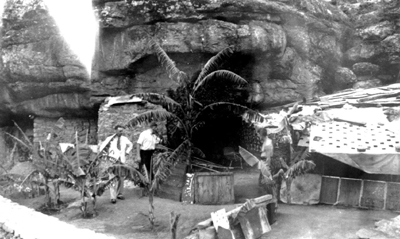
| Hermit's Cave Complex in 1936 http://en.wikipedia.org/wiki/... |

created single-handedly by reclusive Italian migrant Valerio Ricetti who made this place
his home between about 1929 and 1952 during that time creating his own private
"utopia" using the natural landscape and materials found in the area.
The site is recognised for being a rare example of an Australian hermit's domain and is
listed on the New South Wales State Heritage Register.
his home between about 1929 and 1952 during that time creating his own private
"utopia" using the natural landscape and materials found in the area.
The site is recognised for being a rare example of an Australian hermit's domain and is
listed on the New South Wales State Heritage Register.
| ********** |
| The State Heritage Register New South Wales, Australia http://www.heritage.nsw.gov.au/07_subnav_04b.htm Caves of Australia http://www.showcaves.com/english/au/caves/Hermit.html Valerio Ricetti http://en.wikipedia.org/wiki/Valerio_Ricetti The Black Mountain Project http://www.blackmountainprojects.com/portfolio/heritage/hermit/ |
| ********** |