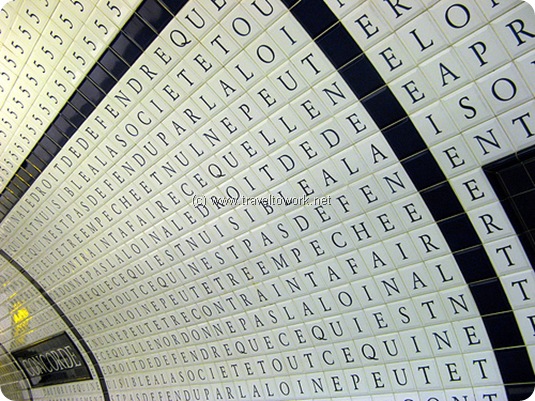
No matter what my destination in Paris, I
seem never to get there without passing
through the Métro station at place de la
Concorde. Aside from making fun of the
sing-song woman's voice trilling
"Attention à la marche en déscendant du
train," my favorite activity while held in
captivity at M° Concorde is trying to pick
out words or phrases from the millions of
tiles, each printed with a letter of the
alphabet, that cover every square
millimetre of the tunnel.
Thanks to my friend, and fellow Our
Paris blogger, Luc, I now know what it is
that I'm supposed to be reading, but have
never been able to make out. The letter
tiles spell out the text of la Déclaration
des droits de l'Homme et du citoyen - the
French constitution adopted by the
Assemblée Nationale in 1789.
It is the brainchild of artist, architect, and
urban planner Françoise Schein. She
states, "I discovered how human rights
principles were a geological bed on which
societies had transformed into permanent,
physical democracies: that is, the
conception, expression and recognition of
human rights was an integral component
in defining the physical form that cities,
societies, and communities ultimately
took. By inscribing this and other
fundamental expressions of the rights of
man in artworks throughout the world,
we leave behind indelible reminders to all
who see them."
Mme Schein's work now appears in cities
throughout Europe, as well as in the
Americas, the Middle East and Asia. She
partners with local non-profit
organizations and volunteers to develop
site-specific projects that relate to the
historic and ongoing struggle for human
rights around the globe. In some sites,
seem never to get there without passing
through the Métro station at place de la
Concorde. Aside from making fun of the
sing-song woman's voice trilling
"Attention à la marche en déscendant du
train," my favorite activity while held in
captivity at M° Concorde is trying to pick
out words or phrases from the millions of
tiles, each printed with a letter of the
alphabet, that cover every square
millimetre of the tunnel.
Thanks to my friend, and fellow Our
Paris blogger, Luc, I now know what it is
that I'm supposed to be reading, but have
never been able to make out. The letter
tiles spell out the text of la Déclaration
des droits de l'Homme et du citoyen - the
French constitution adopted by the
Assemblée Nationale in 1789.
It is the brainchild of artist, architect, and
urban planner Françoise Schein. She
states, "I discovered how human rights
principles were a geological bed on which
societies had transformed into permanent,
physical democracies: that is, the
conception, expression and recognition of
human rights was an integral component
in defining the physical form that cities,
societies, and communities ultimately
took. By inscribing this and other
fundamental expressions of the rights of
man in artworks throughout the world,
we leave behind indelible reminders to all
who see them."
Mme Schein's work now appears in cities
throughout Europe, as well as in the
Americas, the Middle East and Asia. She
partners with local non-profit
organizations and volunteers to develop
site-specific projects that relate to the
historic and ongoing struggle for human
rights around the globe. In some sites,
local women have learned to produce and handpaint tiles--skills that have resulted in
ongoing economic opportunities for women in fragile societies. In Afghanistan, ceramic
craftsmen who only recently had few opportunities for creativity, are today working on
a tile project that expresses their hope for the future.
So, the next time you're in Paris and stopped at M° Concorde, take a moment to ponder
the beliefs inscribed on the walls. Take a moment to thank those who so bravely voiced
those ideas more than 200 years ago...and take a moment to thank Françoise Schein
who has found a way to daily remind us all of their signifance.
ongoing economic opportunities for women in fragile societies. In Afghanistan, ceramic
craftsmen who only recently had few opportunities for creativity, are today working on
a tile project that expresses their hope for the future.
So, the next time you're in Paris and stopped at M° Concorde, take a moment to ponder
the beliefs inscribed on the walls. Take a moment to thank those who so bravely voiced
those ideas more than 200 years ago...and take a moment to thank Françoise Schein
who has found a way to daily remind us all of their signifance.
| Subway on the Sidewalk http://www.nytimes.com/1996/05/12/nyregion/fyi-041440.html http://www.forgotten-ny.com/SUBWAYS/sohomap/sohomap.html |
| Francoise Schein, Time Zone Clock, Millennium Place, 1998-2004 www.modusoperandi-art.com/docs/commission.php?id=7:1:56:30:0 |
Concorde is a station of the Paris Métro. It
is named after the nearby Place de la
Concorde. Concorde is distinctive due to
its décor; the tunnel for line 12 is decorated
with tiles spelling the Déclaration des
Droits de l'Homme et du Citoyen.
en.wikipedia.org/wiki/Concorde_(Paris_M%C3%A9tro)
is named after the nearby Place de la
Concorde. Concorde is distinctive due to
its décor; the tunnel for line 12 is decorated
with tiles spelling the Déclaration des
Droits de l'Homme et du Citoyen.
en.wikipedia.org/wiki/Concorde_(Paris_M%C3%A9tro)
There are several archaic aspects to this map that
show it to be from the 1976-86 period. Among them:
1. No 57 St /6 Ave station (This is probably just a
mistake)
2. JFK Express & Nassau R (RJ) still there (the R,
which normally goes up Broadway. extended to
Chambers Street along Nassau Street along the J/M
tracks till the early 1980s)
3. No 63rd St extension
4. Both sides of Manhattan Bridge operating. The
south side tracks have been closed since 1990;
though the MTA has plans to reopen them, this may
or may not eventually occur.
show it to be from the 1976-86 period. Among them:
1. No 57 St /6 Ave station (This is probably just a
mistake)
2. JFK Express & Nassau R (RJ) still there (the R,
which normally goes up Broadway. extended to
Chambers Street along Nassau Street along the J/M
tracks till the early 1980s)
3. No 63rd St extension
4. Both sides of Manhattan Bridge operating. The
south side tracks have been closed since 1990;
though the MTA has plans to reopen them, this may
or may not eventually occur.
| ********** |
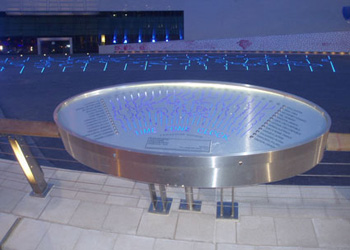
| Schein’s concept depicts international time zones in cast aluminium inlaid with LEDs, integrated into the fabric of Millennium Place. Stainless steel discs locate the capital cities of the world and Coventry's 26 sister cities. At the end of each line the indicators show the hour in that time zone; at the end of the meridian lines Greenwich meantime in hours, minutes and seconds is shown on three indicators. LED lines light up from left to right from midnight, and every quarter of an hour the whole clock is illuminated. A control panel indicates the name and location of Coventry’s sister cities. ‘It seemed appropriate to me, given the Millennium and the fact that the time zone system was invented in Britain, to present an idea related to the concept of time. In addition, Coventry has an important history of industrial clock and watchmaking, and a collection of sister cities from around the globe.’ Francoise Schein |
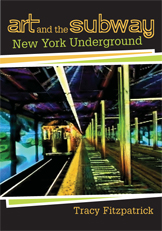
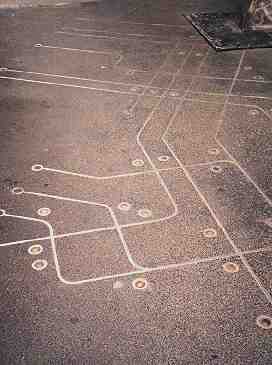
| The landmark sculpture "Subway Map Floating on a New York Sidewalk" was recently featured in Tracy Fitzpatrick's book, "Art and the Subway: New York Undergroundý", Rutgers University Press (2009). Buy now. |
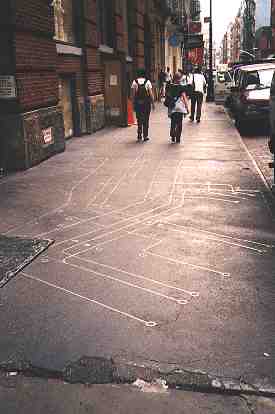
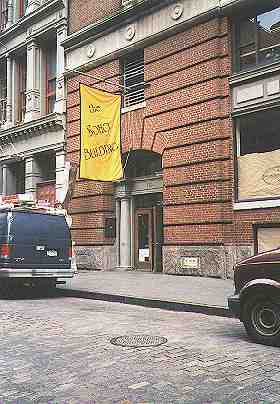
| 1. It is embedded in a sidewalk. 2. The Soho Building on Greene Street between Spring and Prince Streets in New York City. 3. "Subway Map Floating on a New York Sidewalk," was created in 1986 by Francoise Schein, a Belgian artist and architect. |
| ********** |
| ********** |
| New York Transit System Map 1948 www.nycsubway.org... |
| You Learn Something New Every Day http://www.ourparisblog.com/2007/03/you-learn-something-new-every-day.html |
Q. There is a metal inlay on the sidewalk in front of
the SoHo Building at 110 Greene Street, between
Prince and Spring. I always thought it was a
schematic of the subway system, but then a friend
made me look more closely. It looks like computer
circuits. Can you tell me what it is, and why it's
there?
A. You were right with your first guess. It's titled
"Subway Map Floating on a New York Sidewalk,"
and it was created in 1986 by Francoise Schein, a
Belgian artist and architect, who now lives in Paris.
The schematic runs the length of the building -- 87
feet -- and is 12 feet wide.
The IRT, BMT and IND are represented by
half-inch-wide stainless-steel bars embedded in
concrete, with lights indicating SoHo-area subway
stops. The project cost an estimated $30,000 to
produce and won the City Art Commission award
for the best art project that year.
But Ms. Schein's interpretation isn't a match for the
M.T.A.'s -- she combined old and new maps to fit
the space. And it won't get you out of Manhattan. "I
couldn't fit Brooklyn or Queens on the sidewalk,"
she said at the time.
the SoHo Building at 110 Greene Street, between
Prince and Spring. I always thought it was a
schematic of the subway system, but then a friend
made me look more closely. It looks like computer
circuits. Can you tell me what it is, and why it's
there?
A. You were right with your first guess. It's titled
"Subway Map Floating on a New York Sidewalk,"
and it was created in 1986 by Francoise Schein, a
Belgian artist and architect, who now lives in Paris.
The schematic runs the length of the building -- 87
feet -- and is 12 feet wide.
The IRT, BMT and IND are represented by
half-inch-wide stainless-steel bars embedded in
concrete, with lights indicating SoHo-area subway
stops. The project cost an estimated $30,000 to
produce and won the City Art Commission award
for the best art project that year.
But Ms. Schein's interpretation isn't a match for the
M.T.A.'s -- she combined old and new maps to fit
the space. And it won't get you out of Manhattan. "I
couldn't fit Brooklyn or Queens on the sidewalk,"
she said at the time.
| This work is composed of pictograms based on the works of the Swedish botanist Carl von Linné (1707 – 1778) who invented the classification of plants, especially those from his book on his trip to Lapland (1732). www.mairie-lesmureaux.fr/article.php3?id_article=1166 |
| ********** |
| ********** |
| ********** |
| Station Universitetet Stockholm, Sweden Francois Schein |
| ********** |
| "Si tu ignores le nom des choses, même leur connaissance disparaît" If you ignore the name of things, even their existance disappears. Carl von Linné (1755) |
| Françoise Schein, les habitants et la médiathèque (Françoise Schein, local residents and the media library) http://www.mairie-lesmureaux.fr/article.php3?id_article=1166 |
| Historical Maps of the NY Subway System http://www.nycsubway.org/maps/historical.html |
Born in Brussels, Françoise Schein left Belgium after completing her studies in
architecture at the École de la Cambre to study urban design at Columbia University in
New York. She lived there for 11 years.
While in New York, Schein created a work based on cartography. “Subway map
Floating on a NY Sidewalk ” was her first monumental urban sculpture, located on
Green St. in Soho (1985). At that time, almost all of her works were pastel drawings
and sculptures of abstract city landscapes, composed of networks, lines, trajectories,
relating to geography and history. They are constructed of diverse media. Sometimes
they incorporate lighted spaces.
When she returned to Europe in 1989, Schein continued to work on what she called her
laboratory designs while integrating her work into cityscapes, the most important of
which are the Concorde Metro Station in Paris in 1991, and the St. Giles Station in
Brussels in 1992. These two urban projects led her to Lison in 1992 where she lived
for five months while she produced two monumental works for the city at the Parque
metro station (1994), and an additional work for the city of Stockholm at the
Universitetet station (1998).
She continued to travel to cities where she completed a series of projects. She
constructed the Beth Hagefen Jewish-Arab Cultural Center with Michel Butor (1994).
She lived in Berlin where she produced a work at the Westhafen station (2000), which
led her to Bremen to create her first park - the Droits de l'Homme (Human Rights) at
the Rhododendronpark (2002). In Coventry in England she created the monumental
Time Zone Clock (2005). In parallel she established herself in Rio de Janeiro to start
various artistic projects with the underpriveleged, creating seven projects, of which one
is located in Copacabana and the others in six slum areas (1999 to 2007).
In Europe, between 2003 and 2007 she created 19 projects based on European design
with participation of French, Spanish, and Portuguese youth.
Schei is fluent in English and Portugese, in addition to her native French. Her twenty
years of experience with art design and public works have given her the desire to share
architecture at the École de la Cambre to study urban design at Columbia University in
New York. She lived there for 11 years.
While in New York, Schein created a work based on cartography. “Subway map
Floating on a NY Sidewalk ” was her first monumental urban sculpture, located on
Green St. in Soho (1985). At that time, almost all of her works were pastel drawings
and sculptures of abstract city landscapes, composed of networks, lines, trajectories,
relating to geography and history. They are constructed of diverse media. Sometimes
they incorporate lighted spaces.
When she returned to Europe in 1989, Schein continued to work on what she called her
laboratory designs while integrating her work into cityscapes, the most important of
which are the Concorde Metro Station in Paris in 1991, and the St. Giles Station in
Brussels in 1992. These two urban projects led her to Lison in 1992 where she lived
for five months while she produced two monumental works for the city at the Parque
metro station (1994), and an additional work for the city of Stockholm at the
Universitetet station (1998).
She continued to travel to cities where she completed a series of projects. She
constructed the Beth Hagefen Jewish-Arab Cultural Center with Michel Butor (1994).
She lived in Berlin where she produced a work at the Westhafen station (2000), which
led her to Bremen to create her first park - the Droits de l'Homme (Human Rights) at
the Rhododendronpark (2002). In Coventry in England she created the monumental
Time Zone Clock (2005). In parallel she established herself in Rio de Janeiro to start
various artistic projects with the underpriveleged, creating seven projects, of which one
is located in Copacabana and the others in six slum areas (1999 to 2007).
In Europe, between 2003 and 2007 she created 19 projects based on European design
with participation of French, Spanish, and Portuguese youth.
Schei is fluent in English and Portugese, in addition to her native French. Her twenty
years of experience with art design and public works have given her the desire to share
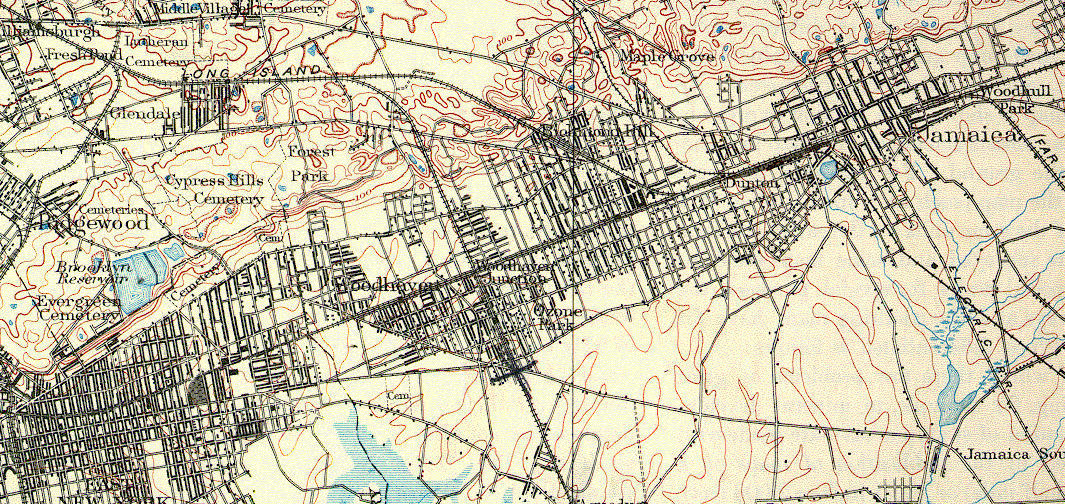
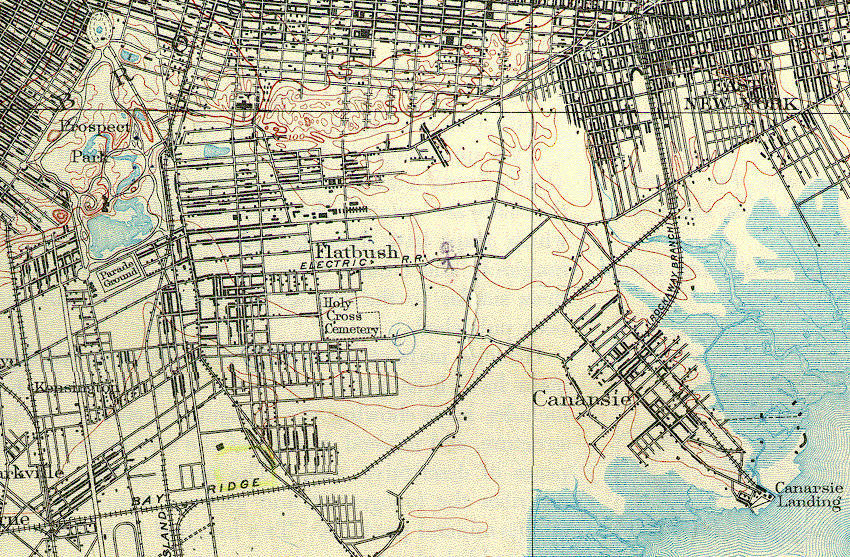
Scan of a USGS survey map of southern Brooklyn, originally drafted in 1888. Railways
and trolley rights-of-way are noted. Courtesy J. Alan Septimus. Smaller maps are
details of
(1) Coney Island
(2) Jamaica
(3) Prospect Park to Canarsie Detail, showing Bay Ridge branch LIRR
(4) Rockaway and Jamaica Bay Area Detail, New York and Rockaway Beach Railroad
and trolley rights-of-way are noted. Courtesy J. Alan Septimus. Smaller maps are
details of
(1) Coney Island
(2) Jamaica
(3) Prospect Park to Canarsie Detail, showing Bay Ridge branch LIRR
(4) Rockaway and Jamaica Bay Area Detail, New York and Rockaway Beach Railroad
| For more information about INSCRIRE, see www.inscrire.com/wordpress_.... |
| (1) |
| Quiz Number 212 7 June 2009 STAY ON TRACK Artist Francoise Schein created this unusual subway map, Without directions to get you out of town or to come in. On NYC sidewalk at the SoHo building on Green Street, Showing a 1986 rendering of the city subway lines within. The map was created using stainless steel bars, Embedded in the concrete of the sidewalk. Even lights indicating the SoHo area stops, And tracks worming around like a beanstalk. The project cost an estimated $ 30,000. dollars, Winning a City Art Commission award when completed. Therefore, someone in the city must have known about it! So It was an honest contest, as no one cheated. Robert Edward McKenna. Quiz Poet Laureate |

 |  |  |  |
| If you have a picture you'd like us to feature a picture in a future quiz, please email it to us at CFitzp@aol.com. If we use it, you will receive a free analysis of your picture. You will also receive a free Forensic Genealogy CD or a 10% discount towards the purchase of the Forensic Genealogy book. |


 |  |  |  |
| Click here to see results of 5th occasional photoquiz survey. |
My quickest solve ever. I knew immediately that it was a subway map. Just had to pin
point it. Jim Kiser
*****
My personal history with NYC is limited. I was taken on school trips to Broadway
Shows twice, it was great, but I have only been on the NYC mass transit system one
time, when I went to the World's Fair in 1965. It was much faster than the
Philadelphia system. I have always been intimidated (yes me! intimidated!) by the NYC
mass transit system... Just thinking about it reminds me of The M.T.A. Song recorded
by the Kingtson Trio in 1959...
"Did he ever return,: No he never returned: And his fate is still unlearn'd: He may ride
forever: 'neath the streets of Boston: He's the man who never returned."
http://en.wikipedia.org/wiki/M.T.A.
One time I went to NYC all alone to meet someone. I took a bus from somewhere near
my cousin's house in Metuchen, NJ. One time. We were given a hotel room that was
occupied by a woman who owned a full length white mink and a full bottle of Norell.
The food at Momma Leone's was mediocre for real Italian food (my step-grandmother
was from Sicily and her food was much better!) so I just concluded that NYC was not
for me. Cold, gray, hostile, scary and over rated. I have, by choice, NEVER driven a
car in NYC because if you park one there with out of state tags... there is an excellent
chance that when you go to move it the tires will be gone. :-)
When I was a girl, the PTA, Philadelphia Transit Authority, ran all the mass transit in
the city. A token was good for a bus, elevated, subway or trolley ride and often
transfers were free or a minimal price. There are only two subway/elevated lines in
Philly... they run from Broad and Olney in the north to somewhere in south Philly under
Broad (14th) Street and from northeast south to center city and then west to 69th St.
That was and is big enough for me. Suzan Farris
*****
[Regarding Francoise Schein's Time Zone Clock] Wow, that is really a pretty neat piece
of art. I am attracted to LED lights. I really like those underbody and interior neon
lights for your cars too. I would love to have purple underbody lights for my black
car. I think it would be cool. My parents think I need to grow up, but my nephews
agree with me and think that I know how to rock it... Karen Kay Bunting
*****
My first impression was that of circuit board designs. Mike Dalton
*****
Thanks for the links. I will check out the magazine.
I'm always fascinated by the tunnels under New York. Remember the show about the
guy who was part lion who lived down there? Nancy J. Court
*****
What a strange thing to do and it took a lot of effort for something that is essentially
useless. It won an award when I think she should have been fined for defacing public
property. Carolyn Cornelius
*****
This was easy for me as it is a fairly common NYC landmark, and as a NYC detective
with 26 years on the job, I would be in serious trouble with my colleageus if I got this
one wrong. Robert W. Steinmann Jr.
point it. Jim Kiser
*****
My personal history with NYC is limited. I was taken on school trips to Broadway
Shows twice, it was great, but I have only been on the NYC mass transit system one
time, when I went to the World's Fair in 1965. It was much faster than the
Philadelphia system. I have always been intimidated (yes me! intimidated!) by the NYC
mass transit system... Just thinking about it reminds me of The M.T.A. Song recorded
by the Kingtson Trio in 1959...
"Did he ever return,: No he never returned: And his fate is still unlearn'd: He may ride
forever: 'neath the streets of Boston: He's the man who never returned."
http://en.wikipedia.org/wiki/M.T.A.
One time I went to NYC all alone to meet someone. I took a bus from somewhere near
my cousin's house in Metuchen, NJ. One time. We were given a hotel room that was
occupied by a woman who owned a full length white mink and a full bottle of Norell.
The food at Momma Leone's was mediocre for real Italian food (my step-grandmother
was from Sicily and her food was much better!) so I just concluded that NYC was not
for me. Cold, gray, hostile, scary and over rated. I have, by choice, NEVER driven a
car in NYC because if you park one there with out of state tags... there is an excellent
chance that when you go to move it the tires will be gone. :-)
When I was a girl, the PTA, Philadelphia Transit Authority, ran all the mass transit in
the city. A token was good for a bus, elevated, subway or trolley ride and often
transfers were free or a minimal price. There are only two subway/elevated lines in
Philly... they run from Broad and Olney in the north to somewhere in south Philly under
Broad (14th) Street and from northeast south to center city and then west to 69th St.
That was and is big enough for me. Suzan Farris
*****
[Regarding Francoise Schein's Time Zone Clock] Wow, that is really a pretty neat piece
of art. I am attracted to LED lights. I really like those underbody and interior neon
lights for your cars too. I would love to have purple underbody lights for my black
car. I think it would be cool. My parents think I need to grow up, but my nephews
agree with me and think that I know how to rock it... Karen Kay Bunting
*****
My first impression was that of circuit board designs. Mike Dalton
*****
Thanks for the links. I will check out the magazine.
I'm always fascinated by the tunnels under New York. Remember the show about the
guy who was part lion who lived down there? Nancy J. Court
*****
What a strange thing to do and it took a lot of effort for something that is essentially
useless. It won an award when I think she should have been fined for defacing public
property. Carolyn Cornelius
*****
This was easy for me as it is a fairly common NYC landmark, and as a NYC detective
with 26 years on the job, I would be in serious trouble with my colleageus if I got this
one wrong. Robert W. Steinmann Jr.
| Answer to Quiz #212 - June 7, 2009 |
| ********** |


| Comments from Our Readers |
| If you enjoy our quizzes, don't forget to order our books! Click here. |
| ********** |


| Quiz #212 Results |
| Visit our blog at www.forensicgenealogy.info/blog. |
| This is a map of the IRT, BMT and IND. |
| 1. What is unusual about it? 2. Where is it located? 3. How did it get there? |
| Congratulations to Our Winners! Gary Sterne Mark Brzys Jim Kiser Linda Templar Alexander Bill Hurley Donald Schulteis Tamura Jones Suzan Farris Diane Burkett Karen Kay Bunting Edee Scott Debbie Sterbinsky Dennis Brann Anne Alves Charles Coats Joe McCabe Kathy Henderson Carl Blessing Teresa Yu Lisa Thaler Maureen O'Connor Elaine C. Hebert Wayne Douglas Charlie Wayne Judy Pfaff Stan Read Sandra McConathy Jim Baker Margaret Waterman Mike Dalton Marilyn Hamill Mike Swierczewski Dave Doucette Jeanne Daily Nancy Court Jason Freeman Albert Brashear Carolyn Cornelius Beth Long Don Draper Betty Chambers Robert W. Steinmann Jr. Gina Hudson Robert Edward McKenna, QPL |
| Many thanks for Milene Rawlinson for suggesting this quiz. |


| ********** |



| (2) |
| (3) |
| (4) |

| 1924 BMT Subway-Elevated Map (Color) www.nycsubway.org/... |

| ********** |

| ********** |
| ********** |



| ********** |

her knowledge and work experience with
others. In 1997 she founded the non profit
association INSCRIRE (TO INSCRIBE),
with the goal of starting projects in
underpriveleged areas in the slums of Brazil
and the suburbs of Europe.
In addition to her artistic group efforts and
social work with INSCRIRE, Françoise
Schein continues to develop her own
works, sculptures, photo-drawings, maps
and videos to express a world not only
made up of areas and abstract networks,
but also of complex knowledge and very
powerful human bonds.
others. In 1997 she founded the non profit
association INSCRIRE (TO INSCRIBE),
with the goal of starting projects in
underpriveleged areas in the slums of Brazil
and the suburbs of Europe.
In addition to her artistic group efforts and
social work with INSCRIRE, Françoise
Schein continues to develop her own
works, sculptures, photo-drawings, maps
and videos to express a world not only
made up of areas and abstract networks,
but also of complex knowledge and very
powerful human bonds.