A butterfly is an insect of the order Lepidoptera. Like all
Lepidoptera, butterflies are notable for their unusual life cycle with
a larval caterpillar stage, an inactive pupal stage, and a spectacular
metamorphosis into a familiar and colourful winged adult form.
Most species are day-flying so they regularly attract attention. The
diverse patterns formed by their brightly coloured wings and their
erratic yet graceful flight have made butterfly watching a hobby.
Butterflies comprise the true butterflies (superfamily Papilionoidea),
the skippers (superfamily Hesperioidea) and the moth-butterflies
(superfamily Hedyloidea). Butterflies exhibit polymorphism,
mimicry and aposematism. Some migrate over long distances.
Some butterflies have evolved symbiotic and parasitic relationships
with social insects such as ants. Butterflies are important
economically as agents of pollination. In addition, a few species are
pests, because they can damage domestic crops and trees in their
larval stage.
Butterfly larvae, or caterpillars, consume plant leaves and spend
practically all of their time in search of food. Although most
caterpillars are herbivorous, a few species such as Spalgis epius
and Liphyra brassolis are entomophagous (insect eating).
Some larvae, especially those of the Lycaenidae, form mutual
associations with ants. They communicate with the ants using
vibrations that are transmitted through the substrate as well as
using chemical signals. The ants provide some degree of protection
to these larvae and they in turn gather honeydew secretions.
Butterfly caterpillars have three pairs of true legs from the thoracic
segments and up to 6 pairs of prolegs arising from the abdominal
segments. These prolegs have rings of tiny hooks called crochets
that help them grip the substrate.
Some caterpillars have the ability to inflate parts of their head to
appear snake-like. Many have false eye-spots to enhance this
effect. Some caterpillars have special structures called osmeteria
which are everted to produce smelly chemicals. These are used in
defense.
Host plants often have toxic substances in them and caterpillars are
able to sequester these substances and retain them into the adult
stage. This helps making them unpalatable to birds and other
predators. Such unpalatibility is advertised using bright red, orange,
black or white warning colours. The toxic chemicals in plants are
often evolved specifically to prevent them from being eaten by
insects. Insects in turn develop countermeasures or make use of
these toxins for their own survival. This "arms race" has led to the
coevolution of insects and their host plants
When the larva is fully grown, hormones are produced, at which
time the larva stops feeding and begins "wandering" in the quest of
a suitable pupation site, often the underside of a leaf.
The larva transforms into a pupa (or chrysalis) by anchoring itself
to a substrate and moulting for the last time. The chrysalis is
usually incapable of movement, although some species can rapidly
move the abdominal segments or produce sounds to scare potential
predators.
The pupal transformation into a butterfly through metamorphosis
has held great appeal to mankind. To transform from the miniature
wings visible on the outside of the pupa into large structures usable
for flight, the pupal wings undergo rapid mitosis and absorb a great
deal of nutrients. If one wing is surgically removed early on, the
other three will grow to a larger size. In the pupa, the wing forms a
structure that becomes compressed from top to bottom and pleated
from proximal to distal ends as it grows, so that it can rapidly be
unfolded to its full adult size. Several boundaries seen in the adult
color pattern are marked by changes in the expression of particular
transcription factors in the early pupa.
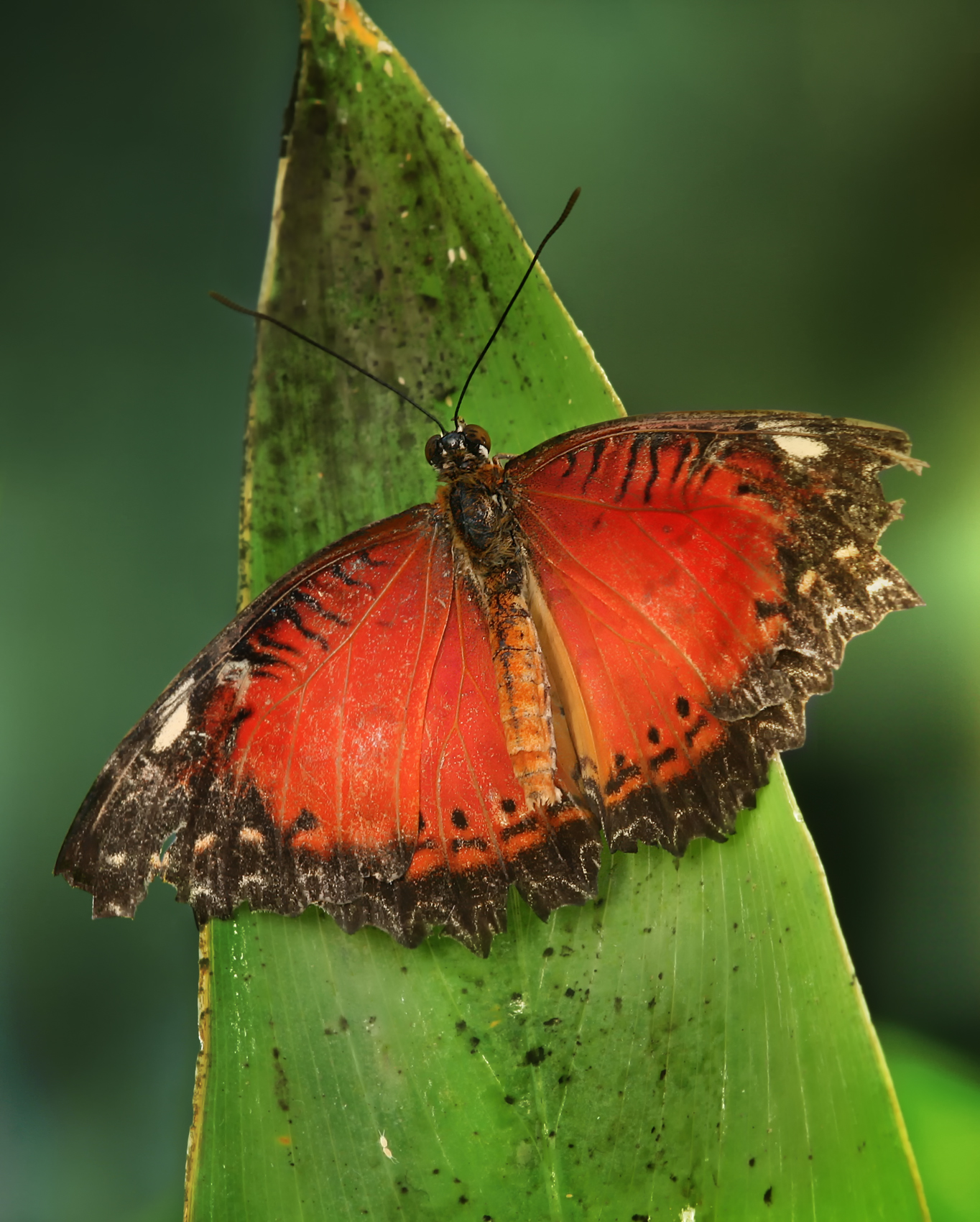
The adult, sexually mature, stage of the insect is known as the
imago. As Lepidoptera, butterflies have four wings that are covered
with tiny scales (see photo). The fore and hindwings are not
hooked together, permitting a more graceful flight. An adult
butterfly has six legs, but in the nymphalids, the first pair is
reduced. After it emerges from its pupal stage, a butterfly cannot
fly until the wings are unfolded. A newly-emerged butterfly needs
to spend some time inflating its wings with blood and letting them
dry, during which time it is extremely vulnerable to predators.
Some butterflies' wings may take up to three hours to dry while
others take about one hour. Most butterflies and moths will excrete
excess dye after hatching. This fluid may be white, red, orange, or
in rare cases, blue.
Lepidoptera, butterflies are notable for their unusual life cycle with
a larval caterpillar stage, an inactive pupal stage, and a spectacular
metamorphosis into a familiar and colourful winged adult form.
Most species are day-flying so they regularly attract attention. The
diverse patterns formed by their brightly coloured wings and their
erratic yet graceful flight have made butterfly watching a hobby.
Butterflies comprise the true butterflies (superfamily Papilionoidea),
the skippers (superfamily Hesperioidea) and the moth-butterflies
(superfamily Hedyloidea). Butterflies exhibit polymorphism,
mimicry and aposematism. Some migrate over long distances.
Some butterflies have evolved symbiotic and parasitic relationships
with social insects such as ants. Butterflies are important
economically as agents of pollination. In addition, a few species are
pests, because they can damage domestic crops and trees in their
larval stage.
Butterfly larvae, or caterpillars, consume plant leaves and spend
practically all of their time in search of food. Although most
caterpillars are herbivorous, a few species such as Spalgis epius
and Liphyra brassolis are entomophagous (insect eating).
Some larvae, especially those of the Lycaenidae, form mutual
associations with ants. They communicate with the ants using
vibrations that are transmitted through the substrate as well as
using chemical signals. The ants provide some degree of protection
to these larvae and they in turn gather honeydew secretions.
Butterfly caterpillars have three pairs of true legs from the thoracic
segments and up to 6 pairs of prolegs arising from the abdominal
segments. These prolegs have rings of tiny hooks called crochets
that help them grip the substrate.
Some caterpillars have the ability to inflate parts of their head to
appear snake-like. Many have false eye-spots to enhance this
effect. Some caterpillars have special structures called osmeteria
which are everted to produce smelly chemicals. These are used in
defense.
Host plants often have toxic substances in them and caterpillars are
able to sequester these substances and retain them into the adult
stage. This helps making them unpalatable to birds and other
predators. Such unpalatibility is advertised using bright red, orange,
black or white warning colours. The toxic chemicals in plants are
often evolved specifically to prevent them from being eaten by
insects. Insects in turn develop countermeasures or make use of
these toxins for their own survival. This "arms race" has led to the
coevolution of insects and their host plants
When the larva is fully grown, hormones are produced, at which
time the larva stops feeding and begins "wandering" in the quest of
a suitable pupation site, often the underside of a leaf.
The larva transforms into a pupa (or chrysalis) by anchoring itself
to a substrate and moulting for the last time. The chrysalis is
usually incapable of movement, although some species can rapidly
move the abdominal segments or produce sounds to scare potential
predators.
The pupal transformation into a butterfly through metamorphosis
has held great appeal to mankind. To transform from the miniature
wings visible on the outside of the pupa into large structures usable
for flight, the pupal wings undergo rapid mitosis and absorb a great
deal of nutrients. If one wing is surgically removed early on, the
other three will grow to a larger size. In the pupa, the wing forms a
structure that becomes compressed from top to bottom and pleated
from proximal to distal ends as it grows, so that it can rapidly be
unfolded to its full adult size. Several boundaries seen in the adult
color pattern are marked by changes in the expression of particular
transcription factors in the early pupa.
The adult, sexually mature, stage of the insect is known as the
imago. As Lepidoptera, butterflies have four wings that are covered
with tiny scales (see photo). The fore and hindwings are not
hooked together, permitting a more graceful flight. An adult
butterfly has six legs, but in the nymphalids, the first pair is
reduced. After it emerges from its pupal stage, a butterfly cannot
fly until the wings are unfolded. A newly-emerged butterfly needs
to spend some time inflating its wings with blood and letting them
dry, during which time it is extremely vulnerable to predators.
Some butterflies' wings may take up to three hours to dry while
others take about one hour. Most butterflies and moths will excrete
excess dye after hatching. This fluid may be white, red, orange, or
in rare cases, blue.
Family: Wild Silk Moths (Saturniidae)
Subfamily: Giant Silkworm Moths (Saturniinae)
Identification: Body is red with a white collar and white bands on the abdomen.
Wings are dark brown with white hairlike scales giving a frosted appearance; forewings
are red at the base. Crescent spots and the area outside the postmedian line are red on
all wings.
Subfamily: Giant Silkworm Moths (Saturniinae)
Identification: Body is red with a white collar and white bands on the abdomen.
Wings are dark brown with white hairlike scales giving a frosted appearance; forewings
are red at the base. Crescent spots and the area outside the postmedian line are red on
all wings.
| #4. The Glasswing Butterfly |
| ********** |
| Hyalophora Cecropia2 |
| Hyalophora Cecropia2 |
| ********** |
Indeed, there are many beautiful
butterflies. Moths far outnumber
butterflies in the Lepidoptera order, but
get less attention because moths usually
are more somber
colored and active nocturnally. The
Cecropia moth is noteworthy because it is
beautiful and large sized. Anyone living
east of the Rockies that sees a Cecropia in
butterflies. Moths far outnumber
butterflies in the Lepidoptera order, but
get less attention because moths usually
are more somber
colored and active nocturnally. The
Cecropia moth is noteworthy because it is
beautiful and large sized. Anyone living
east of the Rockies that sees a Cecropia in
| A butterfly crysalis |
Searching on "orange and black butterfly" will lead you to many websites on the
Monarch Butterfly.
Monarch Butterfly.
You will notice several images of butterfly #4, the Glasswing Butterfly. Eventually you
will come across one of the best butterfly photo galleries at www.butterflyutopia.com.
will come across one of the best butterfly photo galleries at www.butterflyutopia.com.
| #1. The Monarch Butterfly |
the wild will remember the occasion. I've seen two over eight decades. The following
website is pertinent. www.butterfliesandmoths.org/species?l=3281. Stan Read
website is pertinent. www.butterfliesandmoths.org/species?l=3281. Stan Read
| ********** |
| Found in Central America, from Mexico to Panama, the Glasswing Butterfly (Greta Oto) is a brush-footed butterfly where its wings are transparent. The tissue between the veins of its wings looks like glass. worldmysteries9.blogspot.com... |
The regal orange and
black monarch butterfly
is one of nature's
marvels. It is famous for
its beauty and especially
for its travels.
Monarchs, like many
birds, fly south for the
winter. Some travel as
far as 2000 miles to
warm wintering grounds.
Their migration begins in
August or September.
They travel by day and
stop occasionally, every
few days, to feed. They
black monarch butterfly
is one of nature's
marvels. It is famous for
its beauty and especially
for its travels.
Monarchs, like many
birds, fly south for the
winter. Some travel as
far as 2000 miles to
warm wintering grounds.
Their migration begins in
August or September.
They travel by day and
stop occasionally, every
few days, to feed. They
| The Butterfly http://en.wikipedia.org/wiki/Butterfly |
Monarchs from the western part of North
America gather in California along the
Pacific coast and in central Mexico.
Monarchs from eastern North America
gather in Mexico as well as parts of
Florida and Texas. Once at their wintering
grounds, they gather in trees and hang in
huge clusters that may contain hundreds
of butterflies. They do this to keep warm,
and they only leave the trees to feed.
When spring arrives, some mate and then
begin their journey back north. Others
begin their journey and mate along the
way. They lay their eggs on milkweed
plants on their way home. Most do not
live long enough to make it all the way
America gather in California along the
Pacific coast and in central Mexico.
Monarchs from eastern North America
gather in Mexico as well as parts of
Florida and Texas. Once at their wintering
grounds, they gather in trees and hang in
huge clusters that may contain hundreds
of butterflies. They do this to keep warm,
and they only leave the trees to feed.
When spring arrives, some mate and then
begin their journey back north. Others
begin their journey and mate along the
way. They lay their eggs on milkweed
plants on their way home. Most do not
live long enough to make it all the way
| How to Solve the Puzzle |
There are several great websites for images of butterflies. You can discover them by
searching for on Google Images, using the word "butterfly" with a few descriptive
words. For example, using the term "transparent butterfly" you will come up with:
searching for on Google Images, using the word "butterfly" with a few descriptive
words. For example, using the term "transparent butterfly" you will come up with:

 |  |  |  |
often travel as far as 80 miles in a single day. They follow the same routes and land in
the same areas as millions and millions of monarchs before them even though most of
them never made the trip before.
the same areas as millions and millions of monarchs before them even though most of
them never made the trip before.
| If you have a picture you'd like us to feature a picture in a future quiz, please email it to us at CFitzp@aol.com. If we use it, you will receive a free analysis of your picture. You will also receive a free Forensic Genealogy CD or a 10% discount towards the purchase of the Forensic Genealogy book. |
Monarchs spend the freezing nights clustered
in mountain fir trees for warmth. The morning
sun warms the clusters until the butterflies
explode in a swarm of color to spend the day
feeding in meadows. arkansasagnews.uark.edu/...
in mountain fir trees for warmth. The morning
sun warms the clusters until the butterflies
explode in a swarm of color to spend the day
feeding in meadows. arkansasagnews.uark.edu/...


Surfing on the words "bright blue butterfly" will get you to several sites with
information on the Blue Morpho.
information on the Blue Morpho.


 |  |  |  |
| 1. Monarch 2. Morpho Blue 3. Pink Dotted Appollonia 4. Glasswing Butterfly 5. The Eighty-Eight |
| ********** |
| Click here to see results of 5th occasional photoquiz survey. |
back to their starting point. The eggs laid along the way hatch, and those young
butterflies continue the flight back north to the homeplace of their parents. Through the
summer, they mate and lay eggs as well. It usually takes 2-3 generations of monarch
butterflies to complete the migration cycle. It is the children or grandchildren of the
butterflies in Mexico or California that return there the next winter.
Read more about the Monarch Butterfly. Click here.
butterflies continue the flight back north to the homeplace of their parents. Through the
summer, they mate and lay eggs as well. It usually takes 2-3 generations of monarch
butterflies to complete the migration cycle. It is the children or grandchildren of the
butterflies in Mexico or California that return there the next winter.
Read more about the Monarch Butterfly. Click here.
| Answer to Quiz #214 - June 21, 2009 |
| ********** |
| #2. Blue Morpho |
| ********** |
| Blue morpho butterflies, inhabitants of Central and South America's dense forests, can be up to 6 inches (15 centimeters) wide, and the male's iridescent sheen can been seen by humans up to a thousand yards (one kilometer) away. Here, a female floats through a cloud forest in Costa Rica. environment.nationalgeographic.com/environment/enlarge/bl ue-morpho-rainforest.html |

| #3. The Pink Dotted Appollonia |

Lyropteryx Apollonia. This small Metalmark butterfly has a
unique pattern... Metallic blue-green stripes radiate out
toward the edges of his wings from a black center.
These butterflies are tough to see in the wild because they
fly alone or in very small groups in lowland South
American rainforests. Your best chance to see one at rest
is at a rich mineral source, basking in the sunlight!
unique pattern... Metallic blue-green stripes radiate out
toward the edges of his wings from a black center.
These butterflies are tough to see in the wild because they
fly alone or in very small groups in lowland South
American rainforests. Your best chance to see one at rest
is at a rich mineral source, basking in the sunlight!
| If you enjoy our quizzes, don't forget to order our books! Click here. |
| 2007 Tropical Ecology Institute naturalsciences.org/microsites/... |

| ********** |
This one was hard. You really had to find the website www.butterflyutopia.com to
identify it. Once you find the name, surfing on "Appollonia Butterfly" will give you
more information about it.
identify it. Once you find the name, surfing on "Appollonia Butterfly" will give you
more information about it.
| ********** |
| The parts of a butterfly |
| Quiz #214 Results |
| Visit our blog at www.forensicgenealogy.info/blog. |
This butterfly is found in South America. On the upper side it is black with blue bands
at the margins. The underside of the hind wing has a typical black-and-white pattern
showing an "88" or "89". The underside of the forewing is red with black and white
stripes near the tip. This butterfly lives in wet tropical forests, where it lives on rotting
fruit and dung. It flies from March to November. For more pictures of this stunning
butterfly, see fiveprime.org/hivemind/Tags/88,butterfly.
at the margins. The underside of the hind wing has a typical black-and-white pattern
showing an "88" or "89". The underside of the forewing is red with black and white
stripes near the tip. This butterfly lives in wet tropical forests, where it lives on rotting
fruit and dung. It flies from March to November. For more pictures of this stunning
butterfly, see fiveprime.org/hivemind/Tags/88,butterfly.
| Quiz #200 March 8, 2009 "Free" Press |
| The wings of a butterfly become increasingly damaged as it ages, and do not repair |
| #5. Eighty-Eight Butterfly |
| Butterflies have two antennae, two compound eyes, and a proboscis |
| ********** |
Surfing on "transparent butterfly" will get you to many sites with information about the
Glasswing Butterfly.
Glasswing Butterfly.
This one is funny. You can surf on "butterfly with an 88 on its wing:" or search on
www.butterflyutopia.com to find it.
www.butterflyutopia.com to find it.
| Comments from Our Readers |
| Congratulations to Our Winners Stan Read Tamura Jones Diane Burkett Carolyn Cornelius Chris Hartemink Edee Scott Gary Sterne Charlie Wayne Elaine C. Hebert Milene Rawlinson Robert W. Steinmann, Jr Don Draper Karen Kay Bunting Lisa Thaler Mary South Mike Dalton Rick Mackinney Sandy McConathy Jim Baker Venita Wilson Jocelyn Thayer Emily M. Robert Edward McKenna, QPL |
| Name these types of butterflies. |
I guess I don't feel too bad about not finding [butterfly #3]. There are lots and lots of
butterflies. I don't see this one anywhere else so it must be rare.
There was a wonderful butterfly exhibit at the Smithsonian several years back. I went
with a friend wearing a purple nylon windbreaker. The butterflies thought she was a
giant flower and it was very hard to get her out of the exhibit.
I never go anywhere without my well-worn copy of Butterflies through Binoculars.
Dragonflies are also fascinating. Carolyn Cornelius
*****
Indeed, there are many beautiful butterflies. Moths far outnumber butterflies in the
Lepidoptera order, but get less attention because moths usually are more somber
colored and active nocturnally. The Cecropia moth is noteworthy because it is beautiful
and large sized. Anyone living east of the Rockies that sees a Cecropia in the wild will
remember the occasion. I've seen two over eight decades. The following website is
pertinent. www.butterfliesandmoths.org/species?l=3281. Stan Read
*****
I am guessing about #2- #5....I did see some absolutely gorgeous butterflies while
searching for these though. Thanks for that opportunity. Edee Scott
*****
I spent hours on this and finally had to ask for a hint. Numbers 3 and 5 just wouldn't
yield to anything I searched. There are some amazing butterflies out there. Thanks for
the workout. Milene Rawlinson
*****
Butterflies are so beautiful and there are so many different kinds. I had quite the insect
collection as a kid in S. Indiana. There aren't nearly as many bugs in Michigan. I can
see why people go all over the world to collect butterflies! Mary South
*****
As to first impressions: iron butterfly, butterfly valves, butterfly strokes, butterfly
tattoos, and etc. The monarch was readily recognizable. My success with other images:
use of descriptive words. I am amazed at how many website results there are for
anything connected to a butterfly. Mike Dalton
*****
If nothing else, I have seen thousands of beautiful butterflies and have book marked
some great sites. This quiz even forced me to get out some old field guides that I have
not looked at in years. Jim Baker
*****
What a nice contest this week. Nature, adventure and beauty. Dennis Brann
*****
When we were in Costa Rica we went to a butterfly farm (where they raise butterflies
for butterfly worlds in amusement parks etc) They send the pupa to the exhibits. That
way places don't have to provide food for hungry caterpillars, just for the butterflies.
We also saw an amazing private collection of butterflies and insects. It was incredible.
We took pictures. If you want I could try to unearth them and scan a few and send
them to you to see. Milene Rawlinson
*****
I love #3's name - Pink Dotted Appollonia. Sandra McConathy
butterflies. I don't see this one anywhere else so it must be rare.
There was a wonderful butterfly exhibit at the Smithsonian several years back. I went
with a friend wearing a purple nylon windbreaker. The butterflies thought she was a
giant flower and it was very hard to get her out of the exhibit.
I never go anywhere without my well-worn copy of Butterflies through Binoculars.
Dragonflies are also fascinating. Carolyn Cornelius
*****
Indeed, there are many beautiful butterflies. Moths far outnumber butterflies in the
Lepidoptera order, but get less attention because moths usually are more somber
colored and active nocturnally. The Cecropia moth is noteworthy because it is beautiful
and large sized. Anyone living east of the Rockies that sees a Cecropia in the wild will
remember the occasion. I've seen two over eight decades. The following website is
pertinent. www.butterfliesandmoths.org/species?l=3281. Stan Read
*****
I am guessing about #2- #5....I did see some absolutely gorgeous butterflies while
searching for these though. Thanks for that opportunity. Edee Scott
*****
I spent hours on this and finally had to ask for a hint. Numbers 3 and 5 just wouldn't
yield to anything I searched. There are some amazing butterflies out there. Thanks for
the workout. Milene Rawlinson
*****
Butterflies are so beautiful and there are so many different kinds. I had quite the insect
collection as a kid in S. Indiana. There aren't nearly as many bugs in Michigan. I can
see why people go all over the world to collect butterflies! Mary South
*****
As to first impressions: iron butterfly, butterfly valves, butterfly strokes, butterfly
tattoos, and etc. The monarch was readily recognizable. My success with other images:
use of descriptive words. I am amazed at how many website results there are for
anything connected to a butterfly. Mike Dalton
*****
If nothing else, I have seen thousands of beautiful butterflies and have book marked
some great sites. This quiz even forced me to get out some old field guides that I have
not looked at in years. Jim Baker
*****
What a nice contest this week. Nature, adventure and beauty. Dennis Brann
*****
When we were in Costa Rica we went to a butterfly farm (where they raise butterflies
for butterfly worlds in amusement parks etc) They send the pupa to the exhibits. That
way places don't have to provide food for hungry caterpillars, just for the butterflies.
We also saw an amazing private collection of butterflies and insects. It was incredible.
We took pictures. If you want I could try to unearth them and scan a few and send
them to you to see. Milene Rawlinson
*****
I love #3's name - Pink Dotted Appollonia. Sandra McConathy
| Quiz Number 214 21 June 2009 THE QUIZ IS UP IN THE AIR THIS WEEK! 1. Danaus Plexippus, - Monarch, To find me look for the Butterfly King; I'm THE Monarch. 2. Peleides Limpida. - Morpho, With my beautiful color of blue, take a candid photo. 3. Nymphalidae Itmomiinae - Transparent or Glass Wing, Look right through me if you are searching for a fling. 4. Diethria astala. - Eighty-Nine, You can tell me by my number, it is a good sign. 5. Lyopteryx apollonia. - Pink Dotted, Finding me is easy if you know where I'm spotted. Robert Edward McKenna Quiz Poet Laureate ***** Just this last week We were happy to go The Natl History Museum Has a butterfly show Beautiful butterflies Color galore Butterflies in the air Butterflies on the floor Butterflies on your jacket Butterflies in your hair Butterlies on your bluejeans Butterflies everywhere. When you leave the exhibit Look at your backside To make sure that a butterfly Isn't hitching a ride! Colleen Fitzpatrick Understudy to Quiz Poet Laureate Robert Edward McKenna |


| #1 |
| #2 |
| #3 |
| #4 |
| #5 |


Origin: Peru
Frame Size: 4" x 5"
Average Wingspan: 2"
www.theinsectkingdom.com/products/Lyropteryx_apollonia_Framed-65-12.html
Frame Size: 4" x 5"
Average Wingspan: 2"
www.theinsectkingdom.com/products/Lyropteryx_apollonia_Framed-65-12.html


| ********** |
| ********** |
Life history: Females lay rows
of 2-6 eggs on both sides of the
leaves of small host trees or
shrubs. Eggs hatch in 10-14
days. Young caterpillars feed in
groups on leaves; older
caterpillars are solitary. The
cocoon is attached along its full
length to a twig; to escape
predation by rodents and birds,
the cocoon is usually constructed
in a dark, protected area.
Flight: One flight from
March-July in most of the range;
two flights in the Midwest, from
May-early June and then 2 weeks
later.
of 2-6 eggs on both sides of the
leaves of small host trees or
shrubs. Eggs hatch in 10-14
days. Young caterpillars feed in
groups on leaves; older
caterpillars are solitary. The
cocoon is attached along its full
length to a twig; to escape
predation by rodents and birds,
the cocoon is usually constructed
in a dark, protected area.
Flight: One flight from
March-July in most of the range;
two flights in the Midwest, from
May-early June and then 2 weeks
later.
Wing span: 4 5/16 - 5 7/8 inches (11 - 15 cm).
Caterpillar hosts: Various trees and shrubs including box elder (Acer negundo), sugar
maple (Acer saccharinum), wild cherries and plums (Prunus), apples (Malus), alder and
birch (Betulaceae), dogwoods (Cornus), and willows (Salix).
Adult food: Adults do not feed.
Habitat: Successional habitats in many areas including urban and suburban
environments.
Range: Nova Scotia and Maine south to Florida; west across southern Canada and the
eastern United States to the Rocky Mountains.
Conservation: Not usually required.
NatureServe Global Status: G5 - Demonstrably secure globally, though it may be quite
rare in parts of its range, especially at the periphery.
Management needs: None reported.
Caterpillar hosts: Various trees and shrubs including box elder (Acer negundo), sugar
maple (Acer saccharinum), wild cherries and plums (Prunus), apples (Malus), alder and
birch (Betulaceae), dogwoods (Cornus), and willows (Salix).
Adult food: Adults do not feed.
Habitat: Successional habitats in many areas including urban and suburban
environments.
Range: Nova Scotia and Maine south to Florida; west across southern Canada and the
eastern United States to the Rocky Mountains.
Conservation: Not usually required.
NatureServe Global Status: G5 - Demonstrably secure globally, though it may be quite
rare in parts of its range, especially at the periphery.
Management needs: None reported.
| ********** |


| Scales on a butterfly wing give it its color. |


| ********** |