| XXX |
Comment by Melva Robbins Edmonton, Alberta |
| XXX |
Historical Photos www.iskra.ca/photos.htm# |
See more photos at: www.iskra.ca/photos.htm# |
through centuries of persecution and
three major resettlements. Under Tsar
Alexander I, they were moved to
Molochnye Vody, on the border
between Ukraine and Russia. Under
Nicholas I, they were exiled to
Transcaucasia, along the border of
Georgia and Turkey. There, in 1895,
the Doukhobors refused to fight in
Russia’s war with Turkey, burning all
their weapons in a symbolic protest
against war and militarism.
The furious tsar ordered that the
Doukhobors be scattered throughout
Transcaucasia, "sending the father to
one village, the mother to another and
their children to yet a different village,"
according to Doukhobor lore [oral
history]. The Doukhobors pleaded for
help. It came from Quakers in the
United States, who shared many beliefs
with the Doukhobors, most notably
pacifism and anticlericalism. And it
came from the Russian writer Leo
Tolstoy, whose own personal
philosophy had, by this time, gravitated
into non-violence. Tolstoy called the
Doukhobors a "people of the 25th
century." The Doukhobors, for their
part, called Tolstoy "our father," after
he donated $17,000 from the
publication of his book Resurrection to
help pay for emigration of some 7,500
Doukhobors to Canada in 1898. Despite
this mass emigration, the majority of
Doukhobors remained; many moved to
Southern Russia after the Bolshevik
Revolution in 1917.
three major resettlements. Under Tsar
Alexander I, they were moved to
Molochnye Vody, on the border
between Ukraine and Russia. Under
Nicholas I, they were exiled to
Transcaucasia, along the border of
Georgia and Turkey. There, in 1895,
the Doukhobors refused to fight in
Russia’s war with Turkey, burning all
their weapons in a symbolic protest
against war and militarism.
The furious tsar ordered that the
Doukhobors be scattered throughout
Transcaucasia, "sending the father to
one village, the mother to another and
their children to yet a different village,"
according to Doukhobor lore [oral
history]. The Doukhobors pleaded for
help. It came from Quakers in the
United States, who shared many beliefs
with the Doukhobors, most notably
pacifism and anticlericalism. And it
came from the Russian writer Leo
Tolstoy, whose own personal
philosophy had, by this time, gravitated
into non-violence. Tolstoy called the
Doukhobors a "people of the 25th
century." The Doukhobors, for their
part, called Tolstoy "our father," after
he donated $17,000 from the
publication of his book Resurrection to
help pay for emigration of some 7,500
Doukhobors to Canada in 1898. Despite
this mass emigration, the majority of
Doukhobors remained; many moved to
Southern Russia after the Bolshevik
Revolution in 1917.
| XXX |
| XXX |
| XX |
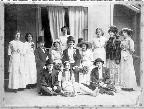
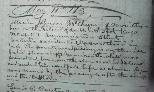
| Front and back of a postcard. 1. To what religious sect does this young woman belong? 2. What famous writer helped pay for her group's immigration? 3. What is the earliest date for the postcard? |

 |  |  |  |
| If you have a picture you'd like us to feature a picture in a future quiz, please email it to us at CFitzp@aol.com. If we use it, you will receive a free analysis of your picture. You will also receive a free Forensic Genealogy CD or a 10% discount towards the purchase of the Forensic Genealogy book. |


 |  |  |  |
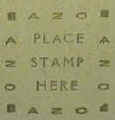
| Artura 5 Ornate Design Real Photo Postcard Guide: The People's Photography, p. 224 tiny.cc/0jk4y |
| ********** |
| ********** |

| If you enjoy our quizzes, don't forget to order our books! Click here. |

| Quiz #314 Results |
| Answer to Quiz #314 July 17, 2011 |

| Answers: 1. Doukhobors, a religious sect that immigrated from Russia to Canada starting in 1899. 2. Leo Tolstoy 3. 1908, based on the style of the "Artura" stamp box. (Some references say 1910). 1908 was also the year that the Doukhobors first settled in British Columbia. Actually, the specific style of the card is the Artura 5 Ornate Postcard. According to Real Photo Postcard Guide: The People's Photography by Bogdan and Weseloh, the earliest known date for this type of card is July 23, 1911. |
| History of the Doukhobors, Spirit Wrestlers of Southern Russia www.molokane.org/molokan/Doukhobor/Rostov_2005_RL/index.html |
| This week's quiz photo was submitted by Quizmaster Shirley Hamblin. |


| ********** |
| Comments from Our Readers |
The place name Lunbrecu Alto meant nothing to Google, but there were hits on Google
images for "Lundbrek Falls, near Crowsnest Pass, Alta.," leading me to believe that Alta
is an abbreviation. Only by trying Google Maps did I find out: "Alta" seems to be the
abbreviation for the province of Alberta! Who knew! ;)
Perhaps Mavra's family settled in Alberta first, then moved to British Columbia, and she
had the photo made before her move! (My ancestors had photos made just before
beginning their emigration to Oregon from "the States" in 1852). Marjorie Wilser
*****
As for the earliest possible date for this post card, I worked my way through various
possibilities. 1897 was the first guess. That’s when the Russian government agreed to
let them leave the country. 1899 was when a large group went to Canada. Now the
writing on the post card isn’t great (there was no spell-check on pens and pencils), but
if it should have said Grand Forks, British Columbia, then 1909-1913 would be the time
frame. That’s when the Doukhobors settled there. Then I figured out that I had been
researching down the wrong path. I believe the actual earliest date is 1910. Artura
post cards were made between 1910 and 1924. Upon learning that I felt like an idiot
for not taking the easy path first. Carol Farrant
*****
Again, this was a very interesting story of another bit of information that I have never
heard of. You are amazing! Thanks. Barbara Battles
*****
I'd never heard of the Doukhobors before and found the research fascinating. Thanks
for helping me fulfill my goal of learning something new every day! Patty Kiker
*****
Here was a case where a little knowledge was a dangerous thing, at least for a while. I
thought at first that she (is she the Mavra N. Chornova named on the card?) might be
an Old Believer – we have several communities of Old Believers in our area, and my
wife worked at the school in the village of Voznesenka for a number of years – but her
clothing is wrong. Nonetheless, I doggedly pursued that notion until I tried Old Believer
emigration, which led to Russian emigration, where i ran across the Tolstoy foundation,
thence to Aleksandra Tolstoy; finally Leo, and the Doukhobors. And their arrival in
Alberta in 1899, and the purchase of property and subsequent move to the Grand Forks
area in 1908. Whew. A far cry from my attempts to find a solution in one or two
searches! Wonderfully interesting additions to my history knowledge, and a reminder
that I haven't read much Tolstoy: time I did. Thank you. Peter Norton
*****
Colleen, I really liked this one! Took some thought! Roberta Martin
*****
I googled address on postcard and came up with doukhober.org website which gives a
post 1910 history of sect. I found more relevant contest details on wikipedia.
Comments: then and in present day religious sects do not always have the blessings of
established governments or religions when they choose to separate themselves from
their confines. Usually they have a strong charismatic leader and a communal lifestyle.
Problems may arise if there disagreements with the leader or philosophical differences;
and/ or if followers come to sense that communal lifestyle restricts their own personal
freedoms. Mike Dalton
*****
Wow! This was a toughie. I kept going around in circles trying to look up variations
of 'Ukrainian' (a guess), 'woman', 'native dress', 'post card' (and 'postcard'). Finally, I
noticed the name 'Artura' around the stamp square, and I looked that up. That led me
to the knowledge that the postcard could be from no earlier than 1908.
Back to figuring out the rest of the info. I kept going on with searches similar to above
with the added info. I also added 'Chornova' which was written, upside down, in the
address box. It didn't help. *Finally,* (I don't know why I didn't do this sooner), I
searched 'Grand' 'British Columbia'. (Yeah, I know why I didn't do it sooner -- I
wasn't sure what the word after 'Grand' was. From that search, I found 'Grand
Forks", and it was downhill from there. The first section of the Wikipedia article about
Grand Forks had a link to the Doukhobors, which gave me the rest of the information.
Cindy Tarsi
*****
www.doukhobor.org has a wealth of information about this group’s beliefs and
movements. Many burials for cemeteries are listed here. One I found was Mavrunia
W Navokshonoff (1888 - Oct. 31, 1975), in the SION Cemetery, Grand Forks. I know
it’s a long shot but could this be Mavra N?
My family lived in an area of western Manitoba Canada where many immigrants from
Russia first settled in the early 1890’s. My parents grew up and married in Brandon and
I was born in Dauphin where there is an annual Ukrainian festival. I was very young
when we moved to the east coast but I was told many stories about our western roots.
It seems many of the Russian immigrants lived in what was called the “Flats” in
Brandon - the flood plains of the Assiniboine River which had very serious flooding this
year. Of course this was viewed as a poorer section of town. It was separated from the
main settlement by the Trans-Canada railway which really enabled the growth of the
west. A census of the western provinces was done in 1906 and 1916 to track
movement of people. Many names of Russian origin are in these records. In Manitoba,
their origins are often shown as Galician (from Galicia - an area of what is now
Western Ukraine.) I did some indexing for “Automated Genealogy” and could see the
difficulties census enumerators had with spelling of Russian names. The Doukhobors
had land in northern Saskatchewan initially reserved for them starting 1899 but my
experiences have taught me they weren’t the only, or the first Russian migrants to
populate the western provinces of Canada. Don Draper
*****
The earliest date for the postcard would have been 1906, the year that the first post
office was established, in Lundbreka Alta, Grand Forks, Alberta.
I kind of had the same thought about the stamp box--that the stamp inditia might not
have been cast within the same time-frame as when the post office opened--but I did
not really examine this, except for reading the text. I saw the post office information in
a couple of places. Of course, you can't always know when to trust a "source" and
there could be different interpretations of "post office" (a building or a service) or "date"
(month? year?), etc Annette McLane
*****
This is amazing, I have never heard of these folks. Of course in America, we are
familiar with the Amish, Mennonites, Quakers, & other sects. I wonder however, how
many people in Canada are aware of these people and their rich heritage? The key for
me in solving was the B.C. on the postcard, so my search terms were religious sect
British Columbia-> and I got it on the first hit. Robert W. Steinmann Jr.
images for "Lundbrek Falls, near Crowsnest Pass, Alta.," leading me to believe that Alta
is an abbreviation. Only by trying Google Maps did I find out: "Alta" seems to be the
abbreviation for the province of Alberta! Who knew! ;)
Perhaps Mavra's family settled in Alberta first, then moved to British Columbia, and she
had the photo made before her move! (My ancestors had photos made just before
beginning their emigration to Oregon from "the States" in 1852). Marjorie Wilser
*****
As for the earliest possible date for this post card, I worked my way through various
possibilities. 1897 was the first guess. That’s when the Russian government agreed to
let them leave the country. 1899 was when a large group went to Canada. Now the
writing on the post card isn’t great (there was no spell-check on pens and pencils), but
if it should have said Grand Forks, British Columbia, then 1909-1913 would be the time
frame. That’s when the Doukhobors settled there. Then I figured out that I had been
researching down the wrong path. I believe the actual earliest date is 1910. Artura
post cards were made between 1910 and 1924. Upon learning that I felt like an idiot
for not taking the easy path first. Carol Farrant
*****
Again, this was a very interesting story of another bit of information that I have never
heard of. You are amazing! Thanks. Barbara Battles
*****
I'd never heard of the Doukhobors before and found the research fascinating. Thanks
for helping me fulfill my goal of learning something new every day! Patty Kiker
*****
Here was a case where a little knowledge was a dangerous thing, at least for a while. I
thought at first that she (is she the Mavra N. Chornova named on the card?) might be
an Old Believer – we have several communities of Old Believers in our area, and my
wife worked at the school in the village of Voznesenka for a number of years – but her
clothing is wrong. Nonetheless, I doggedly pursued that notion until I tried Old Believer
emigration, which led to Russian emigration, where i ran across the Tolstoy foundation,
thence to Aleksandra Tolstoy; finally Leo, and the Doukhobors. And their arrival in
Alberta in 1899, and the purchase of property and subsequent move to the Grand Forks
area in 1908. Whew. A far cry from my attempts to find a solution in one or two
searches! Wonderfully interesting additions to my history knowledge, and a reminder
that I haven't read much Tolstoy: time I did. Thank you. Peter Norton
*****
Colleen, I really liked this one! Took some thought! Roberta Martin
*****
I googled address on postcard and came up with doukhober.org website which gives a
post 1910 history of sect. I found more relevant contest details on wikipedia.
Comments: then and in present day religious sects do not always have the blessings of
established governments or religions when they choose to separate themselves from
their confines. Usually they have a strong charismatic leader and a communal lifestyle.
Problems may arise if there disagreements with the leader or philosophical differences;
and/ or if followers come to sense that communal lifestyle restricts their own personal
freedoms. Mike Dalton
*****
Wow! This was a toughie. I kept going around in circles trying to look up variations
of 'Ukrainian' (a guess), 'woman', 'native dress', 'post card' (and 'postcard'). Finally, I
noticed the name 'Artura' around the stamp square, and I looked that up. That led me
to the knowledge that the postcard could be from no earlier than 1908.
Back to figuring out the rest of the info. I kept going on with searches similar to above
with the added info. I also added 'Chornova' which was written, upside down, in the
address box. It didn't help. *Finally,* (I don't know why I didn't do this sooner), I
searched 'Grand' 'British Columbia'. (Yeah, I know why I didn't do it sooner -- I
wasn't sure what the word after 'Grand' was. From that search, I found 'Grand
Forks", and it was downhill from there. The first section of the Wikipedia article about
Grand Forks had a link to the Doukhobors, which gave me the rest of the information.
Cindy Tarsi
*****
www.doukhobor.org has a wealth of information about this group’s beliefs and
movements. Many burials for cemeteries are listed here. One I found was Mavrunia
W Navokshonoff (1888 - Oct. 31, 1975), in the SION Cemetery, Grand Forks. I know
it’s a long shot but could this be Mavra N?
My family lived in an area of western Manitoba Canada where many immigrants from
Russia first settled in the early 1890’s. My parents grew up and married in Brandon and
I was born in Dauphin where there is an annual Ukrainian festival. I was very young
when we moved to the east coast but I was told many stories about our western roots.
It seems many of the Russian immigrants lived in what was called the “Flats” in
Brandon - the flood plains of the Assiniboine River which had very serious flooding this
year. Of course this was viewed as a poorer section of town. It was separated from the
main settlement by the Trans-Canada railway which really enabled the growth of the
west. A census of the western provinces was done in 1906 and 1916 to track
movement of people. Many names of Russian origin are in these records. In Manitoba,
their origins are often shown as Galician (from Galicia - an area of what is now
Western Ukraine.) I did some indexing for “Automated Genealogy” and could see the
difficulties census enumerators had with spelling of Russian names. The Doukhobors
had land in northern Saskatchewan initially reserved for them starting 1899 but my
experiences have taught me they weren’t the only, or the first Russian migrants to
populate the western provinces of Canada. Don Draper
*****
The earliest date for the postcard would have been 1906, the year that the first post
office was established, in Lundbreka Alta, Grand Forks, Alberta.
I kind of had the same thought about the stamp box--that the stamp inditia might not
have been cast within the same time-frame as when the post office opened--but I did
not really examine this, except for reading the text. I saw the post office information in
a couple of places. Of course, you can't always know when to trust a "source" and
there could be different interpretations of "post office" (a building or a service) or "date"
(month? year?), etc Annette McLane
*****
This is amazing, I have never heard of these folks. Of course in America, we are
familiar with the Amish, Mennonites, Quakers, & other sects. I wonder however, how
many people in Canada are aware of these people and their rich heritage? The key for
me in solving was the B.C. on the postcard, so my search terms were religious sect
British Columbia-> and I got it on the first hit. Robert W. Steinmann Jr.
| Congratulations to Our Winners Marjorie Wilser Daniel E. Jolley Deborah Lee Stewart John Chulick Jim Kiser Jamie Waring Carol Farrant Tom Tollefsen Barbara Battles Annette McLane Melva Robbins Margaret Waterman Dennis Brann Patty Kiker Marilyn Hamill Adrienne Walker Stan Read Sue Edminster Collier Smith Peter Norton Margaret Paxton Angel Esparza Roberta Martin Mike Dalton Cindy Tarsi Teresa Yu Don Draper Nicole Blank Rebecca Bare Gary Sterne Donna Jolley Janice M. Sellers Diane Burkett Joyce Veness Joshua Kreitzer Robert W. Steinmann Jr. |

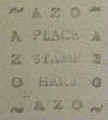
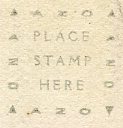
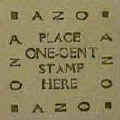
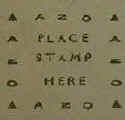
| Dating Postcards |
In my opinion, the most interesting and least noticed way to date a
post card is by the design of the stamp box in the upper right
corner. Postcard companies used different stamp box designs
during different times periods. The earliest date a postcard could
have been manufactured and sent can be estimated from the logo
on the box, and the figures at the corners. Even if the logo did not
change, the corners did. Depending on the company and the time
period of the card, the corners were occupied by squares,
diamonds, circles, triangles, crosses, tildes, or other figures. The
figures in the corners did not have to match - both squares and
triangles could be used on a particular box, and triangles for
post card is by the design of the stamp box in the upper right
corner. Postcard companies used different stamp box designs
during different times periods. The earliest date a postcard could
have been manufactured and sent can be estimated from the logo
on the box, and the figures at the corners. Even if the logo did not
change, the corners did. Depending on the company and the time
period of the card, the corners were occupied by squares,
diamonds, circles, triangles, crosses, tildes, or other figures. The
figures in the corners did not have to match - both squares and
triangles could be used on a particular box, and triangles for
example, could be pointing in any direction. According to Playle's Online Auctions, our
quiz postcard was manufactured between 1908-1924. (But see comment from Daniel
Jolley above, defining the earliest date to 23 July 1911).
quiz postcard was manufactured between 1908-1924. (But see comment from Daniel
Jolley above, defining the earliest date to 23 July 1911).
| Artura postcard stamp box 1908-1924 |
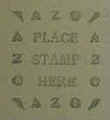
| Examples of AZO Postcard Stamp Boxes: |
| Doukhobor Beliefs The Doukhobors are a Christian sect that hold beliefs similar to the Quakers. White no short description can be a complete statement of any faith community's beliefs, some of the central tenets of the Doukhobors are: Their religious philosophy is based on the two New Testament commandments articulated by Jesus: "Love God with all thy heart, mind and soul," and "Love thy neighbor as thyself." They have many other maxims they adhere to; one of the most popular — coined by Peter Verigin — is "Toil and Peaceful Life." The commandment 'Thou Shalt Not Kill" is of fundamental significance and dictates a Life practice of, pacifism and a rejection of military service. Allegiance to God supersedes allegiance to state or country. They believe that people are capable of divine reason and do not need intermediaries, such as priests, religious ceremonies, Liturgies, churches or icons in order to experience God. They reject the literal interpretations of the Trinity, Heaven and Hell, original sin and the resurrection of Jesus Christ. They believe that bread, salt and water are the basic elements needed to sustain Life and therefore of great religious significance. All Doukhobor meetings and important events are held in the presence of bread, salt and water. They avoid the use of alcohol, tobacco and animal products for food and stray from involvement in partisan politics. Historically, the Doukhobors have at times practiced communal living. The Doukhobors do not depend on the Bible or a psalter, and sing their hymns (many composed from the 18th century to the present) a cappella. Their traditional psalms, hymns and spiritual songs are compiled in The Book of Life (Zhivotnaya Kniga). |
Few in Russia remember the Doukhobors, the pacifist Russian Christian sect
championed by Leo Tolstoy over a century ago. In fact, even the name Doukhobor
evokes little reaction.
"It sounds funny. Perhaps it is an evil house spirit?" guessed Mikhail Grishin, 20, an
engineering student in Rostov-on-Don. His grandmother, Maria Grishina, 80, a retired
schoolteacher, does no better. "Doukhobor sounds like doushegub [murderer]," she
said. Natalia Trifonova, a Rostov University professor, knows of the Doukhobors. "But
they are all gone now," she noted. "To find them you should go to Canada.
"In fact, the Doukhobors are not all gone. An estimated 40,000 still live in Russia and
the countries of the former Soviet Union. About the same number live in Western
Canada, and a few hundred live in the U.S., according to Koozma Tarasoff, a Canadian
historian of the Doukhobors and author of 12 books and hundreds of articles about
their culture. Scattered around Russia, Doukhobor populations are centered in the
Tselina region in Rostov oblast, Cherns region in Tula oblast, near Blagoveshchensk in
Amur oblast and the Mirnoye settlement near Bryansk.
Doukhobors (Doukhobory in Russian), literally means "spirit wrestlers." It was a name
bestowed on the sect — which had previously been known as Ikonobory ("icon
championed by Leo Tolstoy over a century ago. In fact, even the name Doukhobor
evokes little reaction.
"It sounds funny. Perhaps it is an evil house spirit?" guessed Mikhail Grishin, 20, an
engineering student in Rostov-on-Don. His grandmother, Maria Grishina, 80, a retired
schoolteacher, does no better. "Doukhobor sounds like doushegub [murderer]," she
said. Natalia Trifonova, a Rostov University professor, knows of the Doukhobors. "But
they are all gone now," she noted. "To find them you should go to Canada.
"In fact, the Doukhobors are not all gone. An estimated 40,000 still live in Russia and
the countries of the former Soviet Union. About the same number live in Western
Canada, and a few hundred live in the U.S., according to Koozma Tarasoff, a Canadian
historian of the Doukhobors and author of 12 books and hundreds of articles about
their culture. Scattered around Russia, Doukhobor populations are centered in the
Tselina region in Rostov oblast, Cherns region in Tula oblast, near Blagoveshchensk in
Amur oblast and the Mirnoye settlement near Bryansk.
Doukhobors (Doukhobory in Russian), literally means "spirit wrestlers." It was a name
bestowed on the sect — which had previously been known as Ikonobory ("icon
| XXX |
Who was Marva N.? |
| www.doukhobor.org has a wealth of information about this group’s beliefs and movements. Many burials for cemeteries are listed here. One I found was Mavrunia W Navokshonoff (1888-Oct. 31, 1975), in the SION Cemetery, Grand Forks. I know it’s a long shot but could this be Mavra N? Don Draper ***** |
| Wikipedia for Lundbreck, Alberta (that's a ck ending on town on the postcard, the k matching the k in Forks) says: Lundbreck was incorporated in 1907, celebrated |


Photos from top: (1) Natalia Trofimko, a Doukhobor who moved to
Khlebodarnoye in 1992; (2) The oldest surviving Doukhobor house in Petrovka;
(3) Goat and sheep herds near Khlebodarnoye. Agriculture is still the main
source of income; (4) A traditional Doukhobor bow; (5) Anna Sen (Safonova),
center, who helped set up the Museum of Doukhobor Culture and Worship; (6)
Anna Sen (left) and Tatyana Safonova at the Petrovka cemetery. www.molokane.org/molokan
Khlebodarnoye in 1992; (2) The oldest surviving Doukhobor house in Petrovka;
(3) Goat and sheep herds near Khlebodarnoye. Agriculture is still the main
source of income; (4) A traditional Doukhobor bow; (5) Anna Sen (Safonova),
center, who helped set up the Museum of Doukhobor Culture and Worship; (6)
Anna Sen (left) and Tatyana Safonova at the Petrovka cemetery. www.molokane.org/molokan
| time it quickly shrank. If it was incorporated in 1907, it must have been settled then or earlier. I don't think the Doukhobors lived IN Lundbreck, but may have used the post office (present before incorporation?). The postcard clearly says (to me), in both Russian and English, Mavra N. Chornova. While I think that Mavrunia is a diminutive for Mavra, even if Miss Mavra N. Chornova married a Navokshonoff, where does the W come from? Different people, I think. I hope I have time to delve further. For now, I'll stand by my conclusion. Willing to be proven wrong. Peter Norton |
| its centennial in 2007, and was named for two coal miners (Lund and Breckinridge).Lundbreck started out as a coal mining town, that quickly grew to a size of about 1,000 people until the coal mines closed at which |
| The K's |
| Interesting Discovery by Quizmaster Daniel Jolley Establishes earliest date as 23 July 1911 |
To date the postcard, I searched Google for “Artura Postcard” and came upon the link
below which takes you to page 218 of Bogdan and Weseloh’s book which references
Artura under the heading Kodak-Owned Companies and Brands. I then scrolled down
to pages 224 and 225 to find the different designs of the stamp boxes that were used
over the years and the changes in the font. Page 224 is where I found the earliest
known date (EKD) for the type 5 Artura postcard (at least according to Bogdan and
Weseloh).
below which takes you to page 218 of Bogdan and Weseloh’s book which references
Artura under the heading Kodak-Owned Companies and Brands. I then scrolled down
to pages 224 and 225 to find the different designs of the stamp boxes that were used
over the years and the changes in the font. Page 224 is where I found the earliest
known date (EKD) for the type 5 Artura postcard (at least according to Bogdan and
Weseloh).

| versus Quiz Postcard |

| ********** |





fighters") — by a Russian Orthodox
Church priest (originally, the epithet was
Doukhobortsy — "wrestlers against the
Holy Spirit" — and intended as an insult,
but the members of the sect changed it to
the more positive Doukhobors, which
implies a wrestling with the Holy Spirit).
The sect has its roots in the 1650s, when
Patriarch Nikon's reforms of the Russian
Church priest (originally, the epithet was
Doukhobortsy — "wrestlers against the
Holy Spirit" — and intended as an insult,
but the members of the sect changed it to
the more positive Doukhobors, which
implies a wrestling with the Holy Spirit).
The sect has its roots in the 1650s, when
Patriarch Nikon's reforms of the Russian
| Iskra, the official Doukhobor magazine, published in Canada. www.iskra.ca |
Orthodox Church led to the Raskol, the Great Schism. Some of the schismatics
[raskolniks], called Popovtsi ("Priesters") sought a return to pre-reform traditions,
eventually giving way to the movement known as Old Believers. Others, called
Bezpopovtsi ("priestless"), argued for dispensing entirely with priests. Some went
further still, rejecting icons, sacraments, the divinity of Christ and even the Bible. They
became precursors of the Doukhobors, who developed into a distinct religious group by
the early 18th century.
The notion of God within each individual is the cornerstone of Doukhobor belief "This
philosophy has no creeds and does not need any Bible, Church, icons, or priests to
fulfill its needs," Tarasoff explained. "From this notion, we support the moral imperative
that we cannot kill another human being — because then we would be killing the spark
of God in us. The creation of a non-killing society is the essential quest of the
Doukhobors."
Not surprisingly, Russia's tsars saw such pacifism as a threat, as something that could
undermine social order and lead to rebellion. As a result, the Doukhobors suffered
[raskolniks], called Popovtsi ("Priesters") sought a return to pre-reform traditions,
eventually giving way to the movement known as Old Believers. Others, called
Bezpopovtsi ("priestless"), argued for dispensing entirely with priests. Some went
further still, rejecting icons, sacraments, the divinity of Christ and even the Bible. They
became precursors of the Doukhobors, who developed into a distinct religious group by
the early 18th century.
The notion of God within each individual is the cornerstone of Doukhobor belief "This
philosophy has no creeds and does not need any Bible, Church, icons, or priests to
fulfill its needs," Tarasoff explained. "From this notion, we support the moral imperative
that we cannot kill another human being — because then we would be killing the spark
of God in us. The creation of a non-killing society is the essential quest of the
Doukhobors."
Not surprisingly, Russia's tsars saw such pacifism as a threat, as something that could
undermine social order and lead to rebellion. As a result, the Doukhobors suffered
| The Doukhobors of Today have become better understood and their spiritual and cultural heritage has gained worldwide respect and recognition. The USCC (Union of Spritual Communities of Christ, main office in Grand Forks, B.C. Canada) has continued the Slavic tradition of hospitality, symbolized by the Bread, Salt and Water that grace all Doukhobor functions, and has become well known for its acappella choirs with their message of peace and love. Today, recognizing that they live in a global village, Doukhobors are actively engaged, at home and abroad, in the nonviolent pursuit of peace, human rights, social justice, respect for the environment, and in the provsision of aid to those in need. They commonly own facilities and heritage sites, administer and provide a wide range of services, and publish a bilingual journal (ISKRA). They are also stewards of properties, which offer potential for a return to a lifestyle more consistent with their Doukhobor "Life Concept". In 1995, Doukhobors and friends, commemorated the Centennial of their forebears' burning of firearms, and in 1999, the Centennial of their arrival in Canada. As they greet the new millennium, Doukhobors take pride in their history and heritage, and look to the future with optimism, confident that the power of love will triumph over the love of power. |
| ********** |
| For Further Reading |


| ********** |
| Pre-1907-1910 |
| 1945-49 |
| 1910-1930 |
| 1940 |
| Pre-1907-1910 |
| Unknown Date |
| 1911 |
| 1904-1918 |
| (British/Canadian) 1908-1911 |
| ********** |
| ********** |
| The Doukhobors are an interesting group of which we do not hear much these days. They are pacifists and were persecuted in Russia because of their refusal to serve in the Army and adamantly refusing to swear allegiance to tsar Nicholas II. Tolstoy took interest in their plight and helped them immigrate to Canada in 1899, specifically Saskatchewan. They had been promised they wouldn't need to bear arms nor swear allegiance to the Crown. However, eventually, things did not work out that way and they started buying land and moving to the area around Grand Forks in BC. Most lived very peacefully, however, there was one breakaway group, calling themselves the 'Freedom Fighters'. They maintained their position of 'non-resistance to evil by evil means and so as to realize the commandment 'Thou shalt not kill.', they should be destroyed by burning. They did this by burning things like transmission towers, schools, even their home sometimes and were noted for the women burning their clothing and standing passively in the nude. It was a common occurrence in the 50s and 60s. I remember it well. Lundbreck, Alberta is/was a coal mining town, located in Southern Alberta on the eastern end of the Crowsnest Pass. I was not aware there was a Doukhobor Colony in that area. Some years ago I vacationed at Christina Beach which is not far from Grand Forks. The leader of the Doukhobors, Peter 'Lordly' Veregin is buried on a hillside overlooking Brilliant BC. It was a magnificent polished black granite tomb until the Freedom Fighters blew it up. Now it is a steel box covered in several feet of cement. In BC, they built colonies for family groups, usually 2 identical 2-3 storey brick houses with surrounding brick outbuildings. Some still remain standing throughout the countryside. They have maintained one setting near Grand Forks as a museum. I will attach some pictures. Melva Robbins Peter Verigin's tomb overlooking the meeting of the Kootenay and Columbia Rivers. Dedication to Peter Verigin painted on rock face above the tomb. Remains of black marble tomb stacked around cement tomb. Beautifully maintained rose gardens surrounding tomb. Two of the houses with outbuildings in the background. |


| ********** |
| ********** |